There’s a frustration every home cook eventually hits: you spend decent money on chef’s knives, take care of them, use the “correct” cutting board — and then, slowly, the edge goes. Tomatoes crush instead of slice. Onions squirt more than they yield. And you’re standing over a whetstone, watching YouTube tutorials, wondering if you’re making things worse.
The three-stage knife sharpener was supposed to fix that. Coarse, medium, fine — pull through a few times, done. Simple enough that even someone who’s never sharpened a blade can restore a usable edge in under a minute. And for the most part, that promise holds up: the best 3-stage sharpeners do remove the guesswork. The catch is that not all of them are built well enough to trust with good knives.
Some use low-quality abrasives that wear out fast. Others remove metal too aggressively, eating away at the blade instead of just refreshing the edge. A few are genuinely excellent — diamond or ceramic abrasives with proper angle guides and durable construction that hold up through weekly use. The difference between a sharpener that saves your knives and one that shortens their life comes down to a few specific design choices: the abrasive material, whether the angle is fixed or adjustable, and how well the slots align with the blade’s geometry.
This guide covers seven options from about $12 to $170. Two get full deep-dives — they earned a permanent spot on the counter. The others get shorter treatment because they serve narrower use cases, but each has a reason to exist.
Three-stage sharpeners covered here:
Full reviews:
- Chef’s Choice 1520 — the most versatile electric model with adjustable 15°/20° angles
- Presto 08810 — the budget workhorse that’s been reliably sharpening 20° knives for over a decade
Also worth a look:
- Chef’s Choice 15XV — for those committed to converting their whole set to a 15° edge
- Work Sharp WSGFS221 — a compact field kit for hunters, backpackers, and campers
- Sharp Pebble 4KS — a manual sharpener with five selectable angles for hands-on cooks
- Minosharp ASYD101 — water-cooled ceramic wheels designed for thin Japanese-style blades
- Leifod MD04 — an affordable electric 15° sharpener that undercuts the big names but carries some uncertainty
None of these will turn you into a master sharpener, and that’s exactly the point. The right three-stage sharpener just works — consistently, without much thought. The wrong one can turn a perfectly good knife into a narrower, scratch-covered version of its former self. Let’s separate the two.
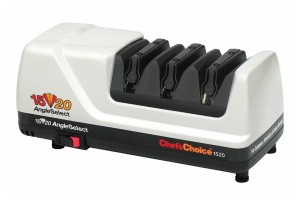
Chef’s Choice 1520
Pulling a knife through the Chef’s Choice 1520 produces a precise, mechanical bite — not a scrape or grind, but something controlled. The blade seats into the guide, the motor doesn’t change pitch; it just pulls the edge across diamond abrasives at a consistent angle. The whole interaction feels engineered, which is exactly what you want when you’re running a $150 chef’s knife through a $110 machine.
What sets the 1520 apart from nearly every other electric three-stage sharpener is AngleSelect: a toggle that lets you choose between a 15° edge and a 20° edge. That one feature makes it viable for both thin Japanese-style blades (usually 15°) and heavier German or European knives (typically 20°). If your knife block is a mix of Shun and Wüsthof, you don’t have to buy two sharpeners or compromise on geometry. You just flip the switch and rerun the blade through the three stages.
The stages themselves are standard for the category: Stage 1 uses coarse diamond abrasives to reshape and repair the edge, Stage 2 refines it, Stage 3 polishes. All three are 100% diamond — not bonded wheels or ceramic — which means consistent, long-lasting abrasion. The guides aren’t spring-loaded; they’re fixed plastic slots that hold the blade at the preset angle. The blade stays square and the edge forms evenly — no wobble, no guesswork.
Where the 1520 shows its age is in the details. The housing is plastic, and at $108 it feels a little light. Not cheap in the functional sense — it’s stable on the counter and the guides align well — but there’s a hollow quality to the casing that makes you wonder how it’ll hold up in ten years. The cord dangles without a wrap or compartment. And the motor, while capable, isn’t a powerhouse. If you’re reviving a completely neglected blade — one that’s been sitting in a drawer for three years with a rolled edge — the 1520 can handle it, but it’ll take repeated passes through Stage 1. It’s not instant gratification on truly dull knives.
That’s the main performance limitation. For any knife that’s been maintained with even occasional honing, the 1520 restores a shaving-sharp edge in under a minute. The Dizor edge geometry Chef’s Choice uses — two facets set at slightly different angles — produces an edge that lasts longer than a single-bevel pull-through sharpener. Whether you’re slicing tomatoes, portioning chicken, or deboning fish, the final edge is crisp and holds up through a full meal prep session.
The 1520 also handles serrated bread knives, something many electric sharpeners skip. You run them through Stage 2 only, and it touches up the scallops without flattening them. Not as thorough as a dedicated serrated sharpener, but for home use it keeps a bread knife from tearing through crust.
Who buys this? Usually someone who’s moved past the $20 pull-through and wants something that won’t wreck their nicer blades. The adjustable angle is the main draw — switch between 15° for a Global set and 20° for that family heirloom carbon steel on the same machine. It’s not the sharpener for someone with one cheap chef’s knife. It’s for when your collection has variety and you want one tool that handles everything without compromise.
The plastic housing keeps the price below the 15XV, which costs nearly $170 for essentially the same mechanics but with spring guides and a stropping stage. For most home cooks, the 1520 is the sweet spot: professional-level diamond abrasives, real angle control, and enough durability for weekly use over years. The motor grumbles a bit on your neglected beater knife, but for the knives you actually care about, it delivers a consistent edge that makes you wonder why you ever bothered with whetstones.
Check Price → Chef’s Choice 1520 on Amazon
Presto 08810
The Presto 08810 has been on the market for over a decade and still costs around $70. In an era of yearly gadget refreshes—new angles, spring-loaded guides, stropping stages—Presto kept this model essentially unchanged because it worked.
The 08810 uses a three-stage diamond system with flexible guides that adjust to different blade thicknesses. There’s a selector on the front—thin, medium, thick—that changes the gap so your fillet knife doesn’t get mangled and your hunting knife doesn’t get missed. Pull a moderately dull chef’s knife through Stage 1 a few times, then Stage 2, then Stage 3, and you’ll get a usable 20° edge that handles tomatoes and onions without argument. That’s it. No angle switching, no stropping, no learning curve.
What you trade for the price is longevity. The diamond abrasives in Stage 1 aren’t replaceable. Eventually they wear down, and when they do, the whole unit is finished. For a home cook sharpening one or two knives every couple of weeks, that’s probably three to four years. Heavy users running five knives through it weekly might get half that. The plastic body feels hollow, and on very thin blades—think flexible fillet knives—the guides can chatter if the thickness selector isn’t dialed in perfectly.
But for the majority of home kitchens running standard 20° stainless chef’s knives, the Presto delivers consistent, repeatable results at half the price of the Chef’s Choice 1520. It won’t outlive your knives, but it’ll outlive the time you spend caring about it—and that’s an honest deal for $70.
Check Price → Presto 08810 on Amazon
Also Worth a Look
Chef’s Choice 15XV is essentially the 1520’s more aggressive sibling—it permanently converts your knives to a 15° edge and adds a stropping stage for a razor finish, but at $170 it only makes sense if you’re ready to commit every blade in your block to that angle.
WORK SHARP WSGFS221 packs diamond plates, ceramic rods, and a leather strop into a clamshell kit that fits in a backpack; it’s the right companion for hunters and campers who need to touch up a field knife mid-trip, but it’s awkward for full-size chef’s knives and demands some manual skill.
Sharp Pebble 4KS gives you five selectable angles (12° to 24°) for around $40, making it a cheap way to experiment with edge geometry if you’re willing to learn a manual process—just know that it won’t work on serrated blades and the base needs a non-slip mat to stay put.
Minosharp ASYD101 uses water-cooled ceramic wheels that keep thin Japanese-style blades from overheating, and its three color-coded slots make the sequence idiot-proof; it’s a genuine niche tool for Global and similar knives, but the ceramic wears faster than diamond and the water reservoir spills if tipped.
Leifod MD04 matches the Chef’s Choice 15XV’s 15° fixed angle at roughly half the price, which makes it tempting for budget-minded converts—but the brand lacks the track record and the motor removes metal more aggressively, so it’s a gamble on long-term knife health.
At a Glance
| Product | Price | Key Spec | Rating | Best For | Where to Buy |
|---|---|---|---|---|---|
| Chef’s Choice 1520 | ~$108 | 15°/20° AngleSelect, diamond abrasives | 4.6 | Mixed knife collections at home | Check Price → |
| Presto 08810 | ~$69 | 3-stage diamond, thickness selector | 4.5 | Budget 20° kitchen sharpening | Check Price → |
| Chef’s Choice 15XV | ~$170 | 15° fixed, spring guides, stropping | 4.6 | Enthusiasts converting to 15° | Check Price → |
| WORK SHARP WSGFS221 | ~$40 | Diamond plates, ceramic, strop, guides | 4.8 | Portable field/outdoor sharpening | Check Price → |
| Sharp Pebble 4KS | ~$40 | 5 angles (12°–24°), diamond stones | 4.5 | Hands-on learning angle control | Check Price → |
| Minosharp ASYD101 | ~$45 | Water-cooled ceramic wheels | 4.6 | Thin Japanese-style knives | Check Price → |
| Leifod MD04 | ~$70 | 15° fixed, diamond abrasive, electric | 4.8 | Budget 15° electric conversion | Check Price → |
What Actually Matters When You’re Buying a 3-Stage Sharpener
The three-stage design sounds simple on paper, but most people who end up disappointed made one of two mistakes: they bought a sharpener that doesn’t match their knife angles, or they underestimated how quickly cheap abrasives wear out.
Abrasive type and longevity. Diamond abrasives last significantly longer than ceramic or bonded wheels. That’s not marketing hype—it’s material science. A 100% diamond stage still cuts effectively after hundreds of uses, whereas ceramic rods lose their bite as the surface glazes over. If you plan to sharpen more than once a month, diamond is the only sensible choice. The trade-off is cost: diamond sharpeners start around $40 and go up, while ceramic-based models like the Minosharp cost about the same but need replacement sooner. Do the math on how often you sharpen before deciding.
Angle compatibility matters more than most realize. A 20° sharpener works beautifully on German-style chef’s knives (Wüsthof, Zwilling, Henckels) but will slowly alter the geometry of a 15° Japanese blade. Conversely, running a 15° sharpener on a 20° knife creates a steeper edge that’s technically sharper but more brittle — expect more frequent touch-ups. If your block has both types, an adjustable-angle model like the Chef’s Choice 1520 isn’t a luxury; it’s the only way to keep each knife at its intended angle without buying two sharpeners. If every knife you own is 20°, the Presto 08810 or any fixed 20° model will serve you just as well for half the price.
Speed isn’t the only difference between electric and manual sharpeners. An electric removes metal faster — great for reviving a neglected blade, but risky if you tend to oversharpen. Manual sharpeners like the Sharp Pebble or the Work Sharp field kit let you feel the edge as you work, building intuition over time. Manual requires a steady hand and three to five minutes per knife. Electric is set-and-forget: you trade tactile feedback for consistency. Neither is better; they suit different temperaments.
Footprint is another factor many overlook. A bulky electric that gets shoved in a cabinet won’t get used often. The best sharpener is the one that stays on your counter and gets pulled out weekly. If counter space is tight, a compact handheld like the Minosharp or a manual pull-through is more practical than a machine you have to dig out and plug in.
Check Price → What Actually Matters When You’re Buying a 3-Stage Sharpener on Amazon
So Which One Should You Buy?
If you own a mix of 15° and 20° knives and want the most forgiving, long-lasting electric sharpener that also handles serrated blades, the Chef’s Choice 1520 makes the most sense — it adapts to your collection instead of forcing you to adapt to it.
If every knife in your block is a standard 20° chef’s knife and you just want something reliable at an affordable price, the Presto 08810 has proven that formula works for over a decade. It’s not fancy. It doesn’t need to be.
For everyone else, the decision narrows fast. Committed 15° edge? Chef’s Choice 15XV or the Leifod, depending how much risk (and money) you’ll tolerate. You spend more weekends camping than cooking? Work Sharp field kit. You enjoy the ritual of manual sharpening and want to experiment with angles? Sharp Pebble 4KS. You own thin Japanese steel and worry about heat damage? Minosharp.
None of these is the single best three-stage sharpener. The right one just makes sure your knives stay sharp — and stays out of the way when they’re not.
Q: Does a 3-stage sharpener remove too much metal compared to a whetstone?
A: Most quality 3-stage sharpeners with diamond abrasives remove less metal per pass than many beginners do with a whetstone, because the angle guides prevent overshooting. The real risk is over-sharpening: running a knife through the coarse stage when only the fine stage is needed. Stick to 2–3 pulls per stage unless the blade is truly damaged.
Q: Can I use a 3-stage sharpener on Japanese knives with a 15° edge?
A: Yes, but only if the sharpener offers a 15° setting or is designed for that angle. Using a fixed 20° sharpener on a 15° blade will gradually alter the edge geometry, making it thicker behind the edge and less agile for precise cuts. Models like the Chef’s Choice 1520 with AngleSelect solve this, while fixed-angle sharpeners require matching your knives to their angle.
Q: Why might my knife still feel dull after using a 3-stage sharpener?
A: Two common reasons: you skipped the fine/polishing stage, or the abrasive surface is worn out. The coarse stage sets the edge, but without the fine stage, the edge remains rough and loses sharpness quickly. If you’ve had the sharpener for several years and used it heavily, inspect the abrasive — diamond plates can glaze over, and ceramic rods lose their bite.
Q: How do I clean and maintain a 3-stage electric sharpener?
A: Unplug it first, then use a dry brush or compressed air to remove metal dust from the slots and guides. For diamond abrasives, a soft eraser can clear embedded residue without damaging the surface. Avoid running water or oil into electric models unless the manufacturer explicitly allows it — most are not sealed against liquids.
Q: Is it normal for a 3-stage sharpener to leave scratches on my blade?
A: Light scratch marks along the edge are normal, especially after the coarse stage, and they typically polish out during the fine stage. Deep or uneven scratches across the blade face usually mean the knife was inserted at an angle or the guides are misaligned. If this happens consistently, check whether the sharpener accommodates your blade thickness and verify you’re pulling straight through.
Q: Can a 3-stage sharpener fix a chipped or rolled edge?
A: A sharpener with a coarse diamond stage can remove small chips (about 1–2 mm deep) by reshaping the edge — expect to spend more passes on the coarse slot. For deeper chips or severely rolled edges, a professional sharpening service is safer, as a home sharpener may remove too much metal trying to compensate, shortening the knife’s lifespan.
{“@context”: “https://schema.org”, “@type”: “FAQPage”, “mainEntity”: [{“@type”: “Question”, “name”: “Does a 3-stage sharpener remove too much metal compared to a whetstone?”, “acceptedAnswer”: {“@type”: “Answer”, “text”: “Most quality 3-stage sharpeners with diamond abrasives remove less metal per pass than many beginners do with a whetstone, because the angle guides prevent overshooting. The real risk is over-sharpening: running a knife through the coarse stage when only the fine stage is needed. Stick to 2–3 pulls per stage unless the blade is truly damaged.”}}, {“@type”: “Question”, “name”: “Can I use a 3-stage sharpener on Japanese knives with a 15° edge?”, “acceptedAnswer”: {“@type”: “Answer”, “text”: “Yes, but only if the sharpener offers a 15° setting or is designed for that angle. Using a fixed 20° sharpener on a 15° blade will gradually alter the edge geometry, making it thicker behind the edge and less agile for precise cuts. Models like the Chef’s Choice 1520 with AngleSelect solve this, while fixed-angle sharpeners require matching your knives to their angle.”}}, {“@type”: “Question”, “name”: “Why might my knife still feel dull after using a 3-stage sharpener?”, “acceptedAnswer”: {“@type”: “Answer”, “text”: “Two common reasons: you skipped the fine/polishing stage, or the abrasive surface is worn out. The coarse stage sets the edge, but without the fine stage, the edge remains rough and loses sharpness quickly. If you’ve had the sharpener for several years and used it heavily, inspect the abrasive — diamond plates can glaze over, and ceramic rods lose their bite.”}}, {“@type”: “Question”, “name”: “How do I clean and maintain a 3-stage electric sharpener?”, “acceptedAnswer”: {“@type”: “Answer”, “text”: “Unplug it first, then use a dry brush or compressed air to remove metal dust from the slots and guides. For diamond abrasives, a soft eraser can clear embedded residue without damaging the surface. Avoid running water or oil into electric models unless the manufacturer explicitly allows it — most are not sealed against liquids.”}}, {“@type”: “Question”, “name”: “Is it normal for a 3-stage sharpener to leave scratches on my blade?”, “acceptedAnswer”: {“@type”: “Answer”, “text”: “Light scratch marks along the edge are normal, especially after the coarse stage, and they typically polish out during the fine stage. Deep or uneven scratches across the blade face usually mean the knife was inserted at an angle or the guides are misaligned. If this happens consistently, check whether the sharpener accommodates your blade thickness and verify you’re pulling straight through.”}}, {“@type”: “Question”, “name”: “Can a 3-stage sharpener fix a chipped or rolled edge?”, “acceptedAnswer”: {“@type”: “Answer”, “text”: “A sharpener with a coarse diamond stage can remove small chips (about 1–2 mm deep) by reshaping the edge — expect to spend more passes on the coarse slot. For deeper chips or severely rolled edges, a professional sharpening service is safer, as a home sharpener may remove too much metal trying to compensate, shortening the knife’s lifespan.”}}]}