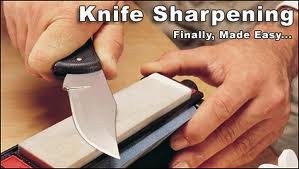
The problem with most knife sharpeners isn’t that they don’t work — it’s that they require more patience than the average home cook has after a long day. Manual stones demand practice. Electric models intimidate with price tags. And the cheap pull-through sharpeners? Some of them actually remove too much metal, shortening blade life.
So what actually qualifies as easy? Something you can use without reading a manual. Something that doesn’t turn a 30-second task into a ten-minute ordeal. Something that leaves a usable edge — not necessarily a razor’s polish, but sharp enough to slice a tomato without crushing it.
This guide is for people who want a sharp knife without becoming a sharpening enthusiast. The best recommendation to emerge from this roundup? The $12 AccuSharp AS010C-BRK. It’s fast, foolproof, and aggressively affordable. But not everyone wants a manual pull-through, and not every kitchen knife needs the same treatment. So we’ve picked six sharpeners across the price spectrum, from $9 to $166, that actually deliver on the “hassle-free” promise — with some important caveats.
AccuSharp AS010C-BRK – The 10-Second Miracle (and the Uncomfortable Truth)
Price: ~$12 | Rating: 4.7 | Check price on Amazon
The AccuSharp looks like a toy. It’s a white plastic handle with two tungsten carbide blades sticking out of a slot. Pull a knife through a few times, and somehow it cuts paper like new. Reviews are overwhelmingly positive, and for good reason: it works.
But here’s the catch this sharpener doesn’t just sharpen — it aggressively grinds. The carbide blades remove steel quickly. Used casually once a week, that’s fine. Used obsessively every day, your knife will wear out faster than with a ceramic hone or a finer abrasive. Many experienced cooks warn that these types of sharpeners are “knife killers” over the long term.
That warning is worth taking seriously — but also worth contextualizing. If your kitchen knives cost $30 each from a department store, replacing them after three years is still cheaper than buying a $100 sharpener. For a home cook who just wants a functional edge without fuss, the AccuSharp delivers exactly what it promises. Ten seconds, sharp edge, no skill required.
Who should buy it: Anyone who needs sharp knives right now and isn’t worried about microscopic wear patterns. It’s also excellent for serrated blades — something most electric sharpeners can’t handle.
Who should skip it: Owners of expensive Japanese knives with thin edges. Those blades are harder and more brittle; the AccuSharp’s aggressive carbide can chip them. For $100+ knives, invest in a proper whetstone or a quality electric.
Chef’s Choice 15XV – When Spending $166 Actually Makes Sense
Price: ~$166 | Rating: 4.6 | Check price on Amazon
This is the sharpener people recommend when they say “just buy a Chef’s Choice.” It’s expensive. It’s bulky. And honestly, it earns its price — for the right users.
The 15XV uses three stages: coarse diamond, fine diamond, and a stropping stage that polishes the edge. The key feature is the 15-degree angle guide, which converts standard factory 20-degree edges into thinner, sharper profiles. That’s a real performance upgrade, not a marketing gimmick.
But it’s not for everyone. The machine is loud — about as loud as a blender. The magnetic guide requires a steady hand; if you wobble, the bevel won’t be uniform. And the price is hard to justify if you only own one chef’s knife.
Where it shines: kitchens with multiple knives. You can run a whole block through in under five minutes. The results are consistent in a way manual sharpeners rarely achieve. And for serrated knives? The 15XV has a separate slot that actually works — rare for electric sharpeners.
The real downside: It’s overkill for someone who just wants a quick edge. If that’s you, the AccuSharp does 80% of the job for 7% of the price.
Leifod MD04-Black – The Middle Ground That Almost Works
Price: ~$70 | Rating: 4.8 | Check price on Amazon
Leifod’s electric sharpener is a direct competitor to Chef’s Choice but at half the price. It has three stages, diamond abrasives, and a 15-degree angle guide. On paper, it looks like the perfect compromise.
In practice, it’s slightly more finicky. The guides aren’t as forgiving as Chef’s Choice; you need to pull the knife straight through or you’ll get an uneven edge. The motor feels less robust — it slows down noticeably on thicker blades. And the dust collection box, while a nice idea, is small and fills quickly.
What it does well: It sharpens faster than you’d expect. A dull Global knife came back to life in about 40 seconds. The polished edge was clean, with a mirror-like finish on the final stage. For the price, it’s genuinely impressive.
What the 4.8 rating doesn’t tell you: A significant minority of reviews mention the unit breaking after 6-12 months. That’s a risk you accept at this price point. If you want reliability, the Chef’s Choice is built like a tank. If you want value and are willing to gamble, the Leifod is a solid bet.
Best suited for: Home cooks with a moderate budget who sharpen every few weeks. Not ideal for daily commercial use.
PAUDIN 5-Stage Knife Sharpener – The Swiss Army Knife of Manual Sharpeners
Price: ~$24 | Rating: 4.5 | Check price on Amazon
Manual pull-through sharpeners usually have two or three slots. This one has five: two coarse diamond, two fine ceramic, and a dedicated slot for scissors. The extra stages mean you can go from “edge is completely gone” to “shaving sharp” in a single session.
How it differs from the AccuSharp: The PAUDIN uses diamond rods instead of tungsten carbide. That’s less aggressive — it removes metal more slowly — but it also produces a smoother edge. Many users report that knives stay sharp longer after using the PAUDIN compared to the AccuSharp.
The scissors slot is a genuine bonus. Most manual sharpeners claim to handle scissors but do a terrible job. The PAUDIN’s slot actually works, with a spring mechanism that holds the blades at the correct angle. It won’t restore a pair of cheap safety scissors, but for kitchen shears? It’s excellent.
The flaw: The plastic housing feels cheap. The coarse diamond rods wear out faster than ceramic; after about a year of moderate use, the coarse slot becomes noticeably less effective. At $24, that’s acceptable — but know that this is not a lifetime tool.
Who should buy: Anyone who wants a versatile, gentle sharpener for a mix of knives and scissors. It’s also good for beginners because the multiple stages make it hard to accidentally ruin a blade.
Sharp Pebble 4KS – For People Who Want to Nerd Out (But Not Too Much)
Price: ~$40 | Rating: 4.5 | Check price on Amazon
This is the weirdest entry on the list: an adjustable-angle manual sharpener. It lets you choose between five angles: 12°, 15°, 18°, 21°, and 24°. Most home cooks never change their sharpening angle. But if you own both a German chef’s knife (usually 20°) and a Japanese Santoku (usually 15°), this single tool can handle both.
How it works: You set the desired angle, then pull the knife through a V-shaped abrasive slot. The adjustment mechanism is a simple dial; it takes five seconds to change.
The trade-off: The abrasives are diamond, but they’re bonded to plastic holders. They work well for the first few months, then lose their bite. Sharp Pebble sells replacement abrasives for about $15, but that brings the total cost to $55 — at which point you might as well buy a fixed-angle system like the PAUDIN.
Who will appreciate this: Cooks with mixed knife collections who want one tool for everything. Also, people who enjoy fine-tuning their edge angle. It’s a gateway drug to proper whetstone sharpening.
Who will hate it: Anyone who just wants to sharpen quickly. The extra adjustment step is a minor annoyance that adds about 30 seconds to the process.
AnySharp ANYSHARPSILVER – The Hands-Free Idea That Mostly Works
Price: ~$15 | Rating: 4.4 | Check price on Amazon
The AnySharp has one clever innovation: a suction base that sticks to your counter, freeing both hands to hold the knife. No clamping. No wrestling with a wobbly sharpener. You press it down, twist, and it stays put.
The sharpening mechanism itself is simple: two tungsten carbide blades set at 20 degrees. Pull the knife through a few times, done. It’s functionally identical to the AccuSharp in terms of cutting performance.
Where it fails: The suction base works on smooth, clean surfaces. On textured laminate or granite with slight imperfections, it pops off mid-sharpening. That’s dangerous — a knife hand slipping while the sharpener detaches is a recipe for cuts.
The verdict: Great idea, imperfect execution. If your counter is perfectly smooth, it’s a solid choice. If not, the AccuSharp is more stable (and costs less).
Quick Comparison Table
| Product | Price | Key Strength | Main Drawback | Best Fit | Rating |
|---|---|---|---|---|---|
| AccuSharp AS010C-BRK | ~$12 | Fast, cheap, works on serrated | Aggressive grit; wears blades faster | Budget-minded home cooks | 4.7 |
| Chef’s Choice 15XV | ~$166 | Professional-grade results, versatile serrated slot | Expensive, noisy, heavy | Serious cooks with multiple knives | 4.6 |
| Leifod MD04-Black | ~$70 | Good price-to-performance ratio | Build quality concerns, inconsistent motor | Value-seeking enthusiasts | 4.8 |
| PAUDIN 5-Stage | ~$24 | Gentle diamond abrasives, scissors slot | Plastic feels cheap, abrasives wear out | Beginners and mixed-knife owners | 4.5 |
| Sharp Pebble 4KS | ~$40 | Adjustable angle for different knife types | Abrasives degrade quickly, extra step to adjust | Knife nerds with mixed collections | 4.5 |
| AnySharp | ~$15 | Suction base frees hands | Suction unreliable on some surfaces | Those with smooth, clean counters | 4.4 |
Buyer’s Guide – What Actually Matters
Don’t overestimate your sharpening needs. Most home cooks sharpen a knife once every few months at most. For that frequency, a $12 AccuSharp is genuinely fine. The extra stages on a $40 sharpener won’t produce a noticeably better edge for occasional use.
Lid design? Not relevant here. But angle selection is. Fixed-angle sharpeners (like AccuSharp and PAUDIN) work well for Western knives with 20-degree edges. If you own Japanese knives with 15-degree edges, look for a sharpener that explicitly supports that angle — or get an adjustable one like the Sharp Pebble.
Diamond vs. tungsten carbide vs. ceramic. Carbide (AccuSharp, AnySharp) is aggressive and fast. Diamond (Leifod, PAUDIN, Sharp Pebble) is slower but more precise. Ceramic is the most gentle but takes longer. For a hassle-free experience, carbide is the bluntest instrument — literally and figuratively. But if you care about edge longevity, go with diamond.
Electric vs. manual. Electric sharpeners (Leifod, Chef’s Choice) are faster and more consistent, but they take up counter space and cost more. Manual sharpeners are smaller, cheaper, and nearly as fast if you have steady hands. The exception: if you have arthritis or hand strength issues, an electric is the easier choice.
The “dulls new knives” myth. Some people think you should never sharpen a new knife because it’s already sharp. That’s incorrect. Factory edges are often ground at a single angle with a coarse abrasive — functional but not optimal. A sharpener can improve the edge geometry, especially if you use a 15-degree guide. Just don’t overdo it.
FAQ
What is the easiest system for a complete beginner?
The AccuSharp AS010C-BRK or the PAUDIN 5-Stage. Both require zero technique. Pull the knife through three to five times, done. No angle guessing, no water stones, no frustration.
Can I use one sharpener for all my kitchen knives?
Yes, if you choose wisely. The Chef’s Choice 15XV has separate slots for straight and serrated blades. For manual options, the PAUDIN handles scissors and both serrated and straight knives. Sharp Pebble’s adjustable angles let you switch between different knife types. Avoid single-angle fixed sharpeners (like the AnySharp) if you own knives with different bevels.
Does a $166 sharpener really outperform a $12 one?
In consistency, yes. The Chef’s Choice produces uniform edges across multiple knives with less effort. It also removes less metal overall because the abrasive is finer. But for a single dull knife, the $12 sharpener can restore a usable edge in 10 seconds. Whether the extra cost matters depends on how many knives you sharpen and how often.
Should I sharpen a brand-new knife?
It depends. Factory edges are often decent but not optimal. If the knife feels sharp out of the box, use it for a few weeks before sharpening. If it feels dull — some budget knives arrive that way — a light pass through a ceramic slot helps. Avoid aggressive carbide on new knives; it will remove the factory edge faster than necessary.
Final Observation
The best knife sharpener is the one you actually use. A $166 machine sitting in a cabinet because it’s too much effort to set up is worse than a $12 pull-through that lives in a drawer. For 2026, the market offers plenty of hassle-free options across every price point — just don’t confuse “ease of use” with “least expensive.” The PAUDIN, for instance, costs twice as much as the AccuSharp but may serve you better over time.
The mug you use every day isn’t the one with the longest feature list. Same with sharpeners. Find the one that fits your counter, your knives, and your patience level. Anything else is just a gadget.