You know that moment. You’re halfway through dicing an onion and suddenly the knife skids off the skin instead of biting into it. You press harder. The blade catches, slips sideways, and you catch yourself wondering if this is how people lose fingertips. The knife isn’t just dull—it’s dangerous.
Most home cooks own at least one sharpener. Maybe it came in a drawer with the rest of the kitchen gadgets. Maybe you picked one up at the grocery store because the package promised “professional results in seconds.” And maybe, like a lot of people, you’ve tried using it once or twice, gotten inconsistent results, and shoved it back in the drawer.
There’s a reason for that frustration. Knife sharpening seems straightforward until you actually try it. The angle, the number of passes, the type of abrasive—each factor changes the outcome, and every sharpener works a little differently. Without a clear method, you’re just dragging metal across metal and hoping for the best.
Walk into any kitchen store or browse Amazon and you’ll find pull-through sharpeners, electric models, whetstones, honing rods, diamond rods, ceramic rods—each one claiming to be the answer. But the best way to use a knife sharpener has nothing to do with which one costs more. It has everything to do with understanding what each tool actually does and matching it to your knives and your skill level.
A dull knife is more likely to cause an injury than a razor-sharp one. When the blade doesn’t cut cleanly, you compensate with force, and that’s when things go wrong. Learning to sharpen correctly isn’t just about performance—it’s about safety. And once you get it right, you’ll never go back to struggling through meal prep.
The tools we’ll cover span the full spectrum of what’s out there. Some you can pick up for pocket change. Others represent a serious investment in your kitchen. Each one has a role, and knowing which role fits your situation is the difference between consistently sharp knives and a drawer full of replacements.
Here are the knives we’ll cover:
Full reviews:
- ACCUSHARP AS010C-BRK — AccuSharp Knife & Tool Sharpener
- Chef’s Choice 15XV — Chef’sChoice EdgeSelect Professional Electric Knife Sharpener
- FANERFUN MD — Knife Sharpener Rod, 13 Inch Honing Steel
Also Worth a Look:
- HENCKELS 11299-401 — HENCKELS Handheld Knife Sharpener
- Sharp Pebble 4KS — 5 Precision Adjust Knife Sharpener (3-Stage)
- AnySharp ANYSHARPSILVER — AnySharp Hands Free Knife Sharpener
These six represent the main approaches to sharpening: aggressive carbide pull-throughs, precision electric systems, simple ceramic manual sharpeners, adjustable angle tools, hands-free options, and the humble honing steel that so many people misunderstand. By the end of this guide, you’ll know exactly how to use each one and—just as importantly—when to use it.
Because there’s no single right way to sharpen a knife. The right tool depends on what you’re sharpening, how often you cook, and how much patience you have. The goal isn’t to find the “best” sharpener in some universal sense. It’s to find the one that works for your knives and your habits.
ACCUSHARP AS010C-BRK — AccuSharp Knife & Tool Sharpener
The AccuSharp isn’t a tool for maintaining your nice Wüsthofs. It’s what you grab when a knife has been neglected so long it’s practically a butter spreader. The tungsten carbide blades inside this $12 plastic handle will restore a usable edge in ten seconds—and they’ll do it on straight blades and serrated ones alike.
But speed costs metal. Carbide is aggressive. Each swipe removes a noticeable amount of metal, so using the AccuSharp regularly will eat through your blade’s life far faster than any ceramic or diamond system. There’s no angle guide either; you’re just pulling the knife through a V-notch and hoping the geometry works out. The resulting edge is sharp but rough, often requiring a ceramic rod or strop to clean up.
For an emergency field sharpener or a tool to keep in a camping kit, it makes sense. For your daily chef’s knife? Not really. Use it once to bring a dead blade back, then hand it off to something gentler for ongoing care.
Check Price → ACCUSHARP AS010C-BRK on Amazon
Chef’s Choice 15XV — Chef’sChoice EdgeSelect Professional Electric Knife Sharpener
The first time you run a decent chef’s knife through a three-stage electric system, the result is almost startling. That sliding-through-a-tomato-with-no-effort feeling most cooks only see in YouTube videos? It happens. The Chef’s Choice 15XV delivers that, and it’s earned a reputation as the gold standard for home electric sharpeners.
At around $170, it’s not a casual purchase. But the engineering behind it explains the price. The sharpening stages use 100% diamond abrasives—not the bonded diamond dust you find in cheaper units, but actual diamond-plated discs that cut fast and stay flat for years. Stage one sets a new 15-degree bevel, converting the standard 20-degree factory edge that most Western knives come with. Stage two hones it. Stage three strops it with a flexible disc that polishes burrs off the edge.
The resulting edge geometry is something most home cooks would never achieve by hand. Fifteen degrees is shallower than what you get from a typical pull-through sharpener, and it makes a noticeable difference in how aggressively a knife bites into food. Onions don’t crush, tomato skins don’t resist—things that used to require a sawing motion suddenly slice cleanly.
There’s a learning curve. The machine follows a specific three-stage sequence, and you need to stick to it. Each stage requires a different number of passes—roughly ten per side for stage one, fewer for stage two and three—and you have to keep count. Skip a stage or rush the passes, and the edge won’t come out right. The flexible spring guides adjust to different blade thicknesses automatically, but they’re not magic. You still need to center the knife properly and draw it through at a steady pace.
The motor is also loud. Not drill-loud, but loud enough that you won’t want to use it while someone else is on the phone in the next room. And the unit itself is bulky—about the size of a small bread box—so it takes up real counter space. If your kitchen is tight, you’ll be storing it in a cabinet and pulling it out when needed.
For straight-edge knives, the 15XV is excellent. Serrated blades work too, but not as effortlessly—you use a separate slot set, and the results are good, just not as refined as straight-edge output.
Whether you need this level of precision depends on your knives and habits. A home cook who sharpens twice a year and uses mid-range knives will probably be fine with a manual ceramic sharpener. The Chef’s Choice 15XV is for people who sharpen monthly, who own knives worth protecting, and who notice—and are annoyed by—the difference between a “good enough” edge and a truly sharp one.
But there’s a catch: that 15-degree edge is more delicate. It cuts beautifully, but dulls faster than a 20-degree edge if you’re cutting on hard surfaces or through bone. You’ll hone more often and resharpen sooner. Many cooks find the trade-off worth it—frequent honing is easy, and the sharpness holds well through each cooking session—but it’s still a compromise.
For anyone who wants the closest thing to a professional sharpening station that fits on a kitchen counter, this is it. The price is high, the learning curve is real, and the machine takes up space. But if you’re the kind of cook who appreciates the difference between a sharp knife and a sharp knife, the Chef’s Choice 15XV delivers that difference every time you use it.
Check Price → Chef’s Choice 15XV on Amazon
FANERFUN MD — Knife Sharpener Rod, 13 Inch Honing Steel
Calling this a “knife sharpener” is doing it a disservice, because it sets the wrong expectation. The FANERFUN MD is a honing steel. It doesn’t sharpen in the sense of removing metal to create a new edge. What it does is realign the microscopic burrs that fold over during normal cutting—the invisible damage that makes a blade feel dull even when it still has plenty of metal left.
The rod is thirteen inches of carbon steel with nickel-chrome plating, magnetized to catch the tiny metal filings that come off during use. That magnetic feature works well; you won’t find little silver specks scattered across your counter afterward. The length handles full chef’s knives in a single stroke, which is more convenient than shorter rods that require multiple passes.
But you can’t take a truly dull knife to this rod and expect results. If the edge is rolled, chipped, or simply worn down from months of use, the steel won’t fix it. That’s when you need a proper sharpener. And if your technique is sloppy—too much angle, too much pressure—you risk scratching the blade face rather than honing the edge.
The steel surface is also less fine than a ceramic rod, so it won’t polish the edge to the same degree. It realigns; it doesn’t refine.
For about $11, it does exactly what a honing steel should. Just don’t expect it to replace a sharpener when the edge is truly gone. Honing every few uses and sharpening when the hone stops helping—that’s the rhythm that keeps knives working.
Check Price → FANERFUN MD on Amazon
Also Worth a Look
HENCKELS 11299-401 — HENCKELS Handheld Knife Sharpener: A two-stage ceramic pull-through that’s about as simple as it gets—good for home cooks who want consistent results on straight-edge knives without overthinking it. But very dull knives will test your patience.
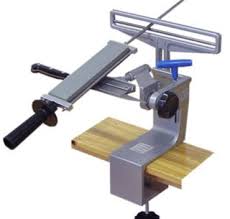
Sharp Pebble 4KS — 5 Precision Adjust Knife Sharpener (3-Stage): A manual system with five angle settings from 12° to 24°, ideal for anyone who wants to learn proper sharpening angles without spending over $100. The plastic build and diamond plate won’t last forever, but the learning value is real.
AnySharp ANYSHARPSILVER — AnySharp Hands Free Knife Sharpener: The standout feature is its suction base that locks to the counter, making one-handed operation possible—useful for cooks with limited hand strength or anyone who’s tired of chasing a sharpener around. The single carbide slot limits it to quick touch-ups rather than full restoration.
At a Glance
| Product | Price | Key Spec | Rating | Best For | Where to Buy |
|---|---|---|---|---|---|
| ACCUSHARP AS010C-BRK — AccuSharp Knife & Tool Sharpener | $11.99 | Tungsten carbide blades | 4.7 | Emergency edge restoration | Check Price → |
| Chef’s Choice 15XV — Chef’sChoice EdgeSelect Professional Electric Knife Sharpener | $169.99 | 3-stage diamond abrasives, 15° edge | 4.6 | Precision sharpening at home | Check Price → |
| FANERFUN MD — Knife Sharpener Rod, 13 Inch Honing Steel | $11.48 | 13″ magnetized honing steel | 4.4 | Daily edge maintenance | Check Price → |
| HENCKELS 11299-401 — HENCKELS Handheld Knife Sharpener | $20.95 | 2-stage ceramic grits | 4.5 | Simple manual sharpening | Check Price → |
| Sharp Pebble 4KS — 5 Precision Adjust Knife Sharpener (3-Stage) | $39.99 | 5 adjustable angles (12°–24°) | 4.5 | Learning sharpening angles | Check Price → |
| AnySharp ANYSHARPSILVER — AnySharp Hands Free Knife Sharpener | $14.99 | Suction base, 20° preset angle | 4.4 | Quick touch-ups | Check Price → |
Choosing the Right Sharpener for Your Situation
Most of the confusion around knife sharpeners comes from people buying the wrong tool for their actual needs. Walk through these factors honestly, and the choice narrows fast.
Most confusion around knife sharpeners comes from buying the wrong tool for your actual needs. Walk through these factors honestly, and the choice narrows fast.
Start with the knives you own. Mid-range stainless steel from a department store set? A simple ceramic pull-through like the HENCKELS ($20.95) keeps them sharp—you don’t need a $170 electric sharpener. But if you’ve invested in high-carbon blades from Wüsthof or Shun ($100+ each), a precision system like the Chef’s Choice 15XV is worth the money. Those knives take and hold a finer edge; a coarse carbide sharpener will damage them over time by removing too much metal.
How often do you actually sharpen? Most home cooks grab a sharpener when the knife gets noticeably dull—every few months. For that pace, a manual pull-through is perfectly adequate. If you hone before every cooking session and sharpen monthly, an electric system or adjustable-angle manual tool justifies the investment. Let frequency drive the quality of the tool.
What’s your tolerance for technique? Some sharpeners are essentially foolproof: pull-throughs with preset angles take almost no skill—draw the knife through the slot, done. Others, like the Sharp Pebble 4KS ($39.99) with five adjustable angles, demand attention and consistency. If you want to learn sharpening as a skill, the adjustable system teaches you something. If you just want sharp knives with zero thinking, go with a fixed-angle manual or electric.
The budget question isn’t about how much money you have—it’s whether the cost matches the use. A $12 AccuSharp that sits in a drawer for a year and gets used twice is a waste, even if cheap. A $170 Chef’s Choice used weekly for years is excellent value. Look at cost per use over the lifespan, not the price tag alone.
The hard truth about aggressive sharpeners: Carbide blades and coarse diamond plates remove metal fast. Great for restoring a neglected blade, but as a primary sharpener they’ll eventually thin out your knife. The edge geometry changes unevenly, and after enough cycles the blade profile warps. If you own quality knives, use carbide sparingly—reserve it for the beater knives.
One factor almost nobody considers: how stable is your sharpening surface? Handheld sharpeners rely on you holding them steady. If you have limited hand strength or cluttered counter space, the AnySharp’s suction base ($14.99) solves that. Stability matters more than most reviews acknowledge—an unstable sharpener gives inconsistent edges and raises the slip risk.
For most home cooks, the right approach is a two-tool system: a honing steel for daily maintenance (you can go weeks or months just honing) and a proper sharpener for when honing stops restoring the edge. That combination costs around $30 and keeps your knives working for years.
A Practical Closing
For serious home cooks with good knives who want a professional edge without sending blades out, the Chef’s Choice 15XV earns its price. It’s for someone who notices the difference between sharp and sharp, cooks often enough that the time saved per slice adds up, and doesn’t mind a modest learning curve for consistent results.
For most people—everyone else—the Sharp Pebble 4KS offers the best value. It teaches proper angles, works manually so there’s nothing to break, and costs around $40. Whether you stick with it forever or use it to learn the basics before upgrading, it gives you control over your edge.
The rest of the tools serve narrower roles: the AccuSharp for emergencies, the honing steel for daily upkeep, the HENCKELS and AnySharp for simplicity. None is wrong—they’re just right for different people.
A dull knife is the most dangerous thing in your kitchen. A sharp one, maintained with the right tool and used with respect, is one of the safest. Pick the approach that fits your knives, your habits, and your patience, and you’ll never go back to wrestling with a blade that won’t cut.
Q: Will using a pull-through sharpener ruin my knife’s edge over time?
A: It depends on the abrasive material. Carbide pull-throughs remove metal aggressively and, if used frequently, will shorten a blade’s lifespan—especially on high-carbon knives. Ceramic or diamond pull-throughs are gentler and suitable for regular maintenance. The key is using the coarsest stage only when reviving a truly dull edge, not as a daily habit.
Q: Can I use an electric sharpener on serrated or ceramic knives?
A: Most electric sharpeners, including the Chef’sChoice 15XV, have dedicated slots for serrated blades, so they work for serrated knives. Ceramic knives, however, are extremely hard and brittle; standard electric or manual sharpeners will chip them. Only diamond abrasives designed specifically for ceramic can safely sharpen them, and even then, results vary.
Q: How many passes should I make on each side of the knife?
A: There is no universal number because it depends on how dull the blade is and the coarseness of the abrasive. A good starting point is 5–10 light passes per stage on each side for a moderately dull knife. Stop and test the edge on a tomato or paper; if it still drags, do another 3–5 passes. Over-sharpening removes unnecessary metal.
Q: How do I know if I’m using the correct sharpening angle?
A: If your sharpener has a preset angle (most pull-throughs do), you’re locked in by design. For adjustable systems, use the manufacturer’s recommended angle (typically 15° for Asian knives, 20° for Western). A quick visual test: after a few passes, look at the edge under light—if you see a shiny strip along the bevel, you’re hitting the metal. If not, you’re too steep or too shallow.
Q: Do I need to lubricate my knife sharpener?
A: Only if the manufacturer specifies it. Most electric and manual pull-through sharpeners are designed to work dry—adding oil or water can clog the abrasives or damage the motor. Whetstones and some diamond plates need water or oil for cooling and to carry away metal particles. Check your sharpener’s manual; never assume lubrication helps.
Q: How do I clean my sharpener and keep it from wearing out?
A: For manual sharpeners, wipe the slots with a dry cloth after each use to remove metal dust. Electric models often have a removable dust collection tray—empty it regularly. Avoid rinsing any sharpener under water unless it’s explicitly marked waterproof. Store it in a dry place to prevent corrosion of metal parts and extend the abrasive life.