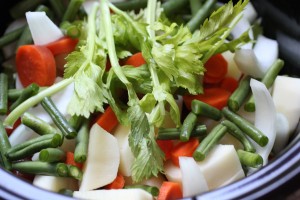
Most people try slow cooker beef stew once. They chunk up some chuck, toss in carrots and potatoes, pour in broth, and set the timer. Eight hours later they lift the lid to find gray, stringy beef in a thin, bland liquid. The potatoes have dissolved into mush. The carrots are either hard or gone. The dream of that rich stew—the kind your grandmother made on the stove all afternoon—feels impossibly out of reach.
It doesn’t have to be that way.
The slow cooker is actually ideal for beef stew. The long, gentle heat breaks down connective tissue in cheaper cuts like chuck, turning them buttery-soft. The problem isn’t the appliance; it’s the recipe. Most dump-and-go recipes skip the small steps that make stew taste like something: browning the meat, sautéing aromatics, deglazing the pan. They promise convenience but deliver disappointment. And the internet is full of variations, many of which contradict each other. Sear first or don’t? Add potatoes at the start or later? Thicken with flour or cornstarch or leave it thin? Easy to get lost.
So what does a truly easy, foolproof slow cooker beef stew recipe look like? One that yields tender beef, intact vegetables, and a rich, hearty broth without requiring a sink full of pans. It exists—but you need the right source.
In this article, we look at the cookbooks and recipe collections that actually deliver. Not ones claiming easy but hiding a dozen prep steps. Not ones sacrificing flavor for speed. The ones that work, reliably, for cooks who want dinner on the table without a science project.
Full reviews:
- Best Slow and Easy Recipes (Cook’s Illustrated) – a favorite among technique-minded home cooks for its rigorously tested, flavor-first approach.
- Fix-It and Forget-It Revised and Updated (Phyllis Good) – the king of dump-and-go, with 700 recipes and a price that’s hard to beat.
Also worth a look:
- The Stay-at-Home Chef Slow Cooker Cookbook (Rachel Farnsworth) – great for visual learners, with companion videos.
- Taste of Home Slow Cooker: 431 Hot & Hearty Classics – reader-submitted recipes with a huge variety.
- Simple Southern Slow Cooker Meals (Hannah Turton) – adds a Southern twist (okra, bacon) to classic stew.
- Slow Cooker Soup And Stew Cookbook (Helena Walker) – focused on healthy, budget-friendly options.
- The Stress-Free Slow Cooker (Stephanie Gigliotti) – ultra-low prep, with recipes requiring 10 minutes or less of active time.
No single cookbook fits every cook. The best choice depends on how much effort you’re willing to invest in flavor—and whether you prioritize technique or pure convenience. Let’s find yours.
Best Slow and Easy Recipes (Cook’s Illustrated)
Let’s deal with the elephant at the start: this book expects you to brown the meat first. For anyone who bought a slow cooker specifically to avoid standing over a hot skillet, that can feel like a betrayal. Why dirty another pan when the whole pitch of a Crock-Pot is set-it-and-forget-it?
Because the difference between a stew that tastes like homework and one that tastes like a Sunday supper is about 12 minutes of active work. And Cook’s Illustrated is the only publisher that explains that equation without talking down to you.
Why the searing step matters
The book’s method for beef stew begins with a straightforward principle: browning builds flavor. They walk you through patting the chuck dry (wet meat steams instead of sears), working in batches so the pan stays hot, and letting a deep brown crust form before flipping. That crust is pure umami—the foundation of a broth that tastes rich and layered rather than boiled and flat.
Once the meat is browned, they deglaze the pan with red wine or broth, scraping up the browned bits (the fond) and pouring it all into the slow cooker. That single step transforms a mediocre broth into something complex. It adds maybe 15 minutes of active time, but it saves hours of wondering why your stew tastes like salty water.
The instructions don’t assume prior experience. They tell you exactly what heat level to use, what kind of oil to pick, and how to tell when the meat is actually browned—not just cooked on the outside. There’s a level of rigor here that you don’t get from a typical collection of reader-submitted recipes.
How the finished stew measures up
Using their recommended cut (beef chuck, for its marbling and connective tissue), proper browning, and a layering trick that adds potatoes and carrots partway through, the result is exactly what you’re after: beef that shreds with a fork, vegetables that hold their shape, and a thick, glossy broth that coats the back of a spoon.
One of their smarter moves is adding a splash of soy sauce or Worcestershire alongside the usual seasonings. Not enough to taste deliberately, but enough to deepen the savory notes. It’s a small adjustment that separates a good stew from a great one.
Where it makes you work
The hardcover price, around $14, is a couple dollars more than the $9 paperbacks stacked next to it at the store. And with 250 recipes, the collection is noticeably smaller than the 700-recipe doorstops on this list. You’re trading quantity for quality—if you cook a new stew every week, you’ll speed through this section faster than you’d like.
Also, this isn’t strictly a slow cooker book. Many recipes are written for the oven or stovetop, so you’ll occasionally need to adapt cook times if you’re committed to using the Crock-Pot. The stew chapter is well-tailored to the appliance, but the book as a whole asks you to be flexible.
Who it’s really for
If the idea of browning meat sounds annoying, this probably isn’t your pick. But if you’ve ever lifted a slow cooker lid to find grey beef floating in watery broth and thought there has to be a better way—this is the book that shows you what that better way looks like. A little more effort upfront, a dramatically better result on the plate.
Fix-It and Forget-It Revised and Updated (Phyllis Good)
If your definition of easy is minimal steps and minimal cost, this is the book. At $8.99, it’s the cheapest option here by a wide margin, and you’ll never run out of variations. Seven hundred recipes, many for beef stew, all built on dump-and-go logic: open a can of cream of mushroom soup, add a packet of onion soup mix, chunk the meat and vegetables, and let the slow cooker do the rest. No browning, no deglazing, no separate pan. Just ingredients in, lid on, dinner later.
The recipes don’t apologize for using shortcuts. They embrace them. Cream-of-anything soups, pre-chopped veggies, canned broth, bottled garlic. If you’ve got a pantry stocked with convenience foods, you’ve got most of what you need already.
How the stew turns out
The flavor is straightforward and familiar—think church potluck or a diner lunch special. It’s not bad, just simple. The broth is thinner than the Cook’s Illustrated version, but a quick stir of cornstarch slurry can fix that. The meat comes out tender because of the long cook time; the vegetables soften more than you might want, so cutting them into large chunks helps.
The biggest win here is the sheer volume of recipes. You’ll never run out of variations: beef stew with mushrooms, beef stew with barley, beef stew with red wine, beef stew with beer. Some are hits, some are misses, but the price per recipe is about a penny.
Where it comes up short
The book suffers from the classic problem of crowd-sourced recipes: uneven quality. One stew might be a keeper; the next could be bland or oddly seasoned. There’s no testing team, no standardization. You’ll need to be comfortable adjusting salt, herbs, and spices on your own.
Also, the instructions are minimal. A typical recipe: “Combine all ingredients in slow cooker. Cook on low for 8 hours.” No guidance on layering, no notes about browning, no warnings about adding dairy too early. There are no step-by-step photos, no nutrition information, and little guidance on cuts of beef beyond what a supermarket shopper already knows. If you know your way around a slow cooker, you can fill in the gaps. If you’re a beginner, you might be disappointed.
Who it’s really for
Budget-conscious cooks who want a huge library of no-fuss options. If your priority is getting dinner on the table with the least amount of effort, and you’re happy with a decent, not great, result, this is your book. Also great for feeding a crowd—the recipes scale easily and the cost is minimal. This is a volume play, not a quality one—and for its intended audience (absolute beginners, busy parents, anyone prioritizing speed over nuance), it delivers exactly what it promises.
Also Worth a Look
The Stay-at-Home Chef Slow Cooker Cookbook (Rachel Farnsworth) – The companion videos are a huge plus for visual learners who want to build flavor without browning meat. But with 120 recipes, the stew options are thinner than the bigger collections.
Taste of Home Slow Cooker (431 Hot & Hearty Classics) – Reader-submitted recipes give you real-world variety and practical tips from home cooks. The flavor ceiling stays moderate, though, because many recipes rely on canned soups and seasoning packets.
Simple Southern Slow Cooker Meals (Hannah Turton) – Adds a regional twist with okra, bacon, and other Southern ingredients if you want your beef stew to taste like it came from a kitchen down South. The recipe count is small, and the rich profile won’t suit everyone.
Slow Cooker Soup And Stew Cookbook (Helena Walker) – Focused entirely on soups and stews with health-conscious, budget-friendly recipes that use economical cuts of beef. Just know some recipes require pre-cooking, like browning ground meat.
The Stress-Free Slow Cooker (Stephanie Gigliotti) – Every recipe needs 10 minutes or less of active prep—ideal for the busiest weeknight cooks. But the 60-recipe collection is small, and the flavors tend toward the simple side.
At a Glance
| Product | Price | Key Spec | Rating | Best For | Where to Buy |
|---|---|---|---|---|---|
| Best Slow and Easy Recipes (Cook’s Illustrated) | $14.18 | 250 recipes, searing technique | 4.5 | Cooks willing to brown meat for superior flavor | Check Price → |
| Fix-It and Forget-It Revised and Updated (Phyllis Good) | $8.99 | 700 recipes, dump-and-go | 4.6 | Beginners on a budget who want maximum convenience | Check Price → |
| The Stay-at-Home Chef Slow Cooker Cookbook (Rachel Farnsworth) | $14.04 | 120 recipes, video tutorials | 4.6 | Visual learners who want flavor without browning | Check Price → |
| Taste of Home Slow Cooker (431 Hot & Hearty Classics) | $16.49 | 431 reader-submitted recipes | 4.6 | Cooks who want huge variety from home-tested recipes |
|---|---|---|---|---|
| Simple Southern Slow Cooker Meals (Hannah Turton) | $21.64 | Southern-style recipes (okra, bacon) | 5.0 | Those seeking regional comfort food twists |
| Slow Cooker Soup And Stew Cookbook (Helena Walker) | $15.75 | Focus on soups/stews, healthy options | 4.5 | Health-conscious cooks on a budget |
| The Stress-Free Slow Cooker (Stephanie Gigliotti) | $19.50 | 60 recipes, 10-min prep | 4.5 | Busiest cooks who prioritize speed over depth |
How to Choose the Right Slow Cooker Beef Stew Cookbook
Every cookbook here promises easy beef stew, but “easy” means different things—and that distinction matters more than anything else. Ask yourself two questions.
How much active time are you willing to spend?
This is the single biggest dividing line. If your answer is “under five minutes and no stovetop work,” books that call for browning meat will frustrate you, no matter how good the results. Fix-It and Forget-It and The Stress-Free Slow Cooker are your lane. They trade depth for speed, and that’s a fair exchange if your evenings leave zero room for extra steps.
If you can spare 15 minutes—enough to brown beef in batches and deglaze the pan—then Cook’s Illustrated opens up a level of flavor you can’t get from seasoning packets alone. The active time isn’t much longer, but the payoff is dramatically better.
What kind of flavor are you aiming for?
One camp relies on processed shortcuts: canned cream of mushroom soup, onion soup mix, jarred gravy. The flavor is familiar, consistent, fine—but it caps out at “good.” Books like Fix-It and Forget-It and Taste of Home operate here.
The other builds flavor from scratch using fresh aromatics, wine or broth, browning, and careful seasoning. Cook’s Illustrated is the standout, but The Stay-at-Home Chef also shows you how to get savory depth without browning (using tomato paste, soy sauce, and Worcestershire). That middle path might be the sweet spot for many cooks.
Budget and variety
At $9, Fix-It and Forget-It Revised and Updated packs more recipes than anything else here—enough to try a different stew every week for a year and a half. Cook’s Illustrated Best Slow and Easy Recipes costs more and gives you fewer dishes, but each one is thoroughly tested and far more likely to deliver a memorable meal. The others land somewhere in between: Taste of Home offers solid variety with a modest flavor ceiling; Simple Southern keeps it smaller and more distinctive; the Soup and Stew book and the Stress-Free cookbook serve narrower audiences.
The Right Pick Depends on You
If you want beef stew that tastes like it simmered all day—rich, deeply savory, with tender meat and intact vegetables—go with Best Slow and Easy Recipes (Cook’s Illustrated). It asks for a little stovetop work and a few more dollars, but the results actually justify owning a slow cooker.
If you want to dump ingredients in a pot and walk away, no extra steps, no second pan, and at the lowest possible price, grab Fix-It and Forget-It Revised and Updated. It won’t wow a food snob, but it will put dinner on the table reliably, and at $9 the math is hard to beat.
For everyone else—the visual learner, the Southern comfort seeker, the health-conscious budgeter, the ultra-busy parent—one of the alternatives above fits better. The right cookbook isn’t the one with the highest rating; it’s the one that matches the energy you’re actually willing to bring to the stove.
Q: Do I need to brown the beef first for slow cooker stew?
A: Not strictly, but browning adds deep flavor through the Maillard reaction. If you skip it, boost umami with a tablespoon of tomato paste and a splash of soy sauce or Worcestershire. The meat will still become tender, but the broth will lack the complexity that comes from searing.
Q: How do I prevent my slow cooker stew from turning out watery?
A: Avoid adding too much liquid at the start—vegetables release water as they cook. For a thicker stew, toss the beef in flour before browning, or stir in a slurry of cornstarch and cold water during the last 30 minutes. Another trick: mash a few cooked potato chunks against the side of the pot to naturally thicken the broth.
Q: Should I add potatoes at the beginning or later?
A: Potatoes become mushy if cooked the full 8 hours. For firmer, intact chunks, add them halfway through cooking. Using waxy potatoes like Yukon Golds also helps them hold their shape better than starchy russets.
Q: What’s the best cut of beef for a slow cooker stew?
A: Beef chuck is the top choice due to its marbling and connective tissue that breaks down into fork-tender meat. Avoid lean cuts like top round, which can become dry and stringy. Brisket also works well but is typically pricier.
Q: Can I leave the slow cooker on low for 8 hours while at work?
A: Yes, modern slow cookers are designed for unattended use and are safe when used according to the manufacturer’s instructions. For beef stew with root vegetables, 8 hours on low yields fork-tender meat and a rich broth. Add any dairy or seafood near the end of cooking rather than at the start.
{"@context": "https://schema.org", "@type": "FAQPage", "mainEntity": [{"@type": "Question", "name": "Do I need to brown the beef first for slow cooker stew?", "acceptedAnswer": {"@type": "Answer", "text": "Not strictly, but browning adds deep flavor through the Maillard reaction. If you skip it, boost umami with a tablespoon of tomato paste and a splash of soy sauce or Worcestershire. The meat will still become tender, but the broth will lack the complexity that comes from searing."}}, {"@type": "Question", "name": "How do I prevent my slow cooker stew from turning out watery?", "acceptedAnswer": {"@type": "Answer", "text": "Avoid adding too much liquid at the start—vegetables release water as they cook. For a thicker stew, toss the beef in flour before browning, or stir in a slurry of cornstarch and cold water during the last 30 minutes. Another trick: mash a few cooked potato chunks against the side of the pot to naturally thicken the broth."}}, {"@type": "Question", "name": "Should I add potatoes at the beginning or later?", "acceptedAnswer": {"@type": "Answer", "text": "Potatoes become mushy if cooked the full 8 hours. For firmer, intact chunks, add them halfway through cooking. Using waxy potatoes like Yukon Golds also helps them hold their shape better than starchy russets."}}, {"@type": "Question", "name": "What's the best cut of beef for a slow cooker stew?", "acceptedAnswer": {"@type": "Answer", "text": "Beef chuck is the top choice due to its marbling and connective tissue that breaks down into fork-tender meat. Avoid lean cuts like top round, which can become dry and stringy. Brisket also works well but is typically pricier."}}, {"@type": "Question", "name": "Can I leave the slow cooker on low for 8 hours while at work?", "acceptedAnswer": {"@type": "Answer", "text": "Yes, modern slow cookers are designed for unattended use and are safe when used according to the manufacturer's instructions. For beef stew with root vegetables, 8 hours on low yields fork-tender meat and a rich broth. Add any dairy or seafood near the end of cooking rather than at the start."}}]}