The problem with portion control isn’t lack of willpower. It’s that eyeballing a serving size when you’re hungry, tired, or rushing between meetings is a losing battle. A handful of peanuts looks very different after a long day. A palm-sized piece of chicken shrinks depending on whose hand you’re using.
Portion control containers solve this by removing the guesswork entirely. No scales. No measuring cups at every meal. Just fill the container, eat what’s inside, stop.
The best option for most people this year is the FIXBODY 7-Piece Portion Control Container Kit at roughly $8. It’s color-coded, includes a tracker, and forces structure without requiring a PhD in nutrition. For those who want something that will survive years of dishwasher abuse, the Rubbermaid Brilliance 2-Compartment set at around $34 is the long-term investment.
This guide covers six very different approaches: budget color-coded systems, premium plastic, compartment trays, bulk packs, glass bariatric containers, and disposable-reusable hybrids. Prices range from about $8 to $48.
Quick Comparison
| Product | Price | Key Strength | Main Drawback | Best Fit | Rating |
|---|---|---|---|---|---|
| FIXBODY 7-Piece | ~$8 | Color-coded system with tracker | Thin plastic feels cheap | First-time portioners, 21-day challenges | 4.5 |
| Rubbermaid Brilliance 2-Comp | ~$34 | StainShield plastic, leakproof | Expensive for plastic | Daily users who want durability | 4.7 |
| Bentgo Prep 20-Piece | ~$14 | Brand reliability, 3-comp trays | Lids can warp in microwave | Office lunch packers | 4.6 |
| Freshware 15-Pack 3-Comp | ~$9.50 | Cheap per container | Thin lids, not leakproof | Bulk meal preppers on a budget | 4.5 |
| GUSTO 50-Count | ~$17 | Disposable-level price, reusable | Not premium feel | High turnover meal prep, families | 4.6 |
| Portion Perfection Bariatric 3-Pack | ~$30 | Glass compartments, bariatric-sized | Small portions only | Post-surgery or very small meals | 4.7 |
Check today’s prices on Amazon
FIXBODY 7-Piece Portion Control Container Kit
Price: ~$8 | Rating: 4.5
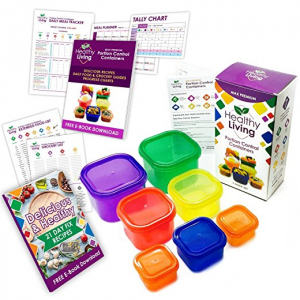
The strongest reason to buy this set is the system behind it. The containers are color-coded—green for vegetables, purple for fruits, red for proteins, yellow for carbs, blue for healthy fats, orange for seeds/dressings—and the included 21-day tracker and recipe ebook turn abstract portion guidelines into a daily habit.
The plastic does feel thin. Not flimsy enough to crack from normal handling, but it lacks the reassuring thickness of Rubbermaid or Bentgo. The lids seal adequately but aren’t leakproof in the way one would trust with soup or wet dressings in a bag. The set is designed for dry-ish meal prep: grilled chicken, rice, chopped vegetables, nuts.
Where this set genuinely works is for people who have never successfully followed a portion plan before. The color coding eliminates the “is this too much?” question. Fill the green container with vegetables. Fill the red with protein. Done. The 21-day tracker adds accountability without feeling punitive.
The containers stack reasonably well when empty, though they don’t nest as efficiently as square designs. The set includes seven pieces: one each of green, purple, red, yellow, blue, orange, and a small orange for seeds. The sizes correspond to the 21 Day Fix program, so it works as a standalone system.
The main drawback is longevity. With daily use and dishwasher cleaning, the printed labels may fade after three to four months. The plastic itself holds up better than expected, but this is not a buy-it-for-life product. It’s a buy-it-to-build-a-habit product.
For roughly the price of two takeout lunches, this set provides enough structure to change how someone eats for three weeks. That’s a fair trade.
Rubbermaid Brilliance Meal Prep Containers, 2-Compartment
Price: ~$34 | Rating: 4.7
Skeptical about spending over thirty dollars on plastic containers. Rubbermaid Brilliance earns the price.
The StainShield plastic resists tomato stains and odor absorption in a way that cheaper containers cannot match. After a week of storing leftover spaghetti bolognese, the container still looks clear. No orange tint. No lingering garlic smell. This matters more than most buyers realize during their first month of meal prep.
The 2.85-cup capacity per container (5-pack) splits into two compartments, which forces a balanced plate without being restrictive. The main compartment holds roughly a cup and a half; the smaller side holds about a cup. Suitable for protein plus vegetables, or vegetables plus a starch.
The sealing mechanism uses latches that fold down over the lid. They create a noticeably airtight seal. One can fill these with soup, tip the container sideways in a work bag, and arrive without leakage. The latches feel solid after six months of use, though the plastic hinges have been known to fatigue after a year in some units.
The clear lids and bases make contents visible without opening. Obvious benefit, but surprisingly rare in the portion control category where many sets use opaque colored plastic.
The drawback is price. At roughly $7 per container, this set costs more per unit than almost anything else in this guide. The other drawback is weight. The thick plastic and reinforced lid structure make these heavier than budget alternatives. Fine for a desk lunch. Less ideal for a backpack commute.
The target buyer is someone who intends to meal prep daily for at least a year and wants containers that still look new at month twelve.
Bentgo Prep – 20-Piece 3-Compartment Meal Prep Containers
Price: ~$14 | Rating: 4.6
Bentgo is the brand people recognize from the bento lunch box category. This 20-piece set (10 trays, 10 lids) extends that reputation into meal prep territory.
Each tray has three compartments. The main compartment holds roughly 1.5 cups, the two side compartments hold about 0.75 cups each. The divider walls are tall enough to keep wet foods from mingling—curry won’t seep into the rice section during transport.
The material is PFAS- and BPA-free plastic. It feels mid-range in thickness. Not as sturdy as Rubbermaid Brilliance, but significantly more substantial than the FIXBODY or Freshware containers. The lids snap on with a satisfying click and seal well enough for most lunch scenarios, though they are not fully leakproof for liquids.
One annoyance surfaces after repeated microwave use. The lids can warp slightly, which affects the seal. The manufacturer includes a venting tab, but users need to remember to open it before microwaving. Warped lids typically still fit, just not as snugly.
The ten-tray quantity is generous. At roughly $1.40 per tray, this set offers strong value for someone who prepacks five lunches for the work week. The navy color hides wear better than clear plastic.
The portability factor is high. The trays stack neatly, and the compact footprint fits standard lunch bags without awkward bulging.
Where this set falls short is portion guidance. Unlike the FIXBODY set, there is no color coding or size differentiation between compartments. Users need to know their own portion targets and fill accordingly.
Freshware Meal Prep Containers [15 Pack] 3 Compartment
Price: ~$9.50 | Rating: 4.5
One overlooked detail about the Freshware set: these containers stack extremely well when filled. The flat lid design and uniform footprint mean a refrigerator shelf can hold six or seven stacked units without wobbling.
The 15-pack includes three-compartment trays with a total capacity of 32 ounces (16-8-8 ounce split between compartments). The compartments are proportioned for a main dish with two sides, which works well for lunch packing.
The plastic is BPA-free but thin. The lids snap on securely but do not create a waterproof seal. Liquid-heavy meals are risky for bag transport. The containers also show scratches and cloudiness after a few dishwasher cycles. Not a problem for the price, but worth noting for anyone expecting long-term clarity.
The lids have a tendency to crack at the corners if over-tightened or dropped. The base trays are more durable than the lids, so some users end up with mismatched sets after a few months.
The value proposition is simply the quantity. Fifteen containers for under ten dollars means one can prep an entire week of lunches plus breakfasts without running out. The microwave safety is real—these handle reheating without leaching or warping—though the compartments can cause uneven heating due to food placement.
For someone starting meal prep with an uncertain commitment level, this set provides a low-cost entry point. If the habit sticks, upgrade to sturdier containers later. If it doesn’t, the financial loss is minimal.
GUSTO 12 oz – 1 Compartment Meal Prep Containers [50 Count]
Price: ~$17 | Rating: 4.6
Fifty containers for roughly seventeen dollars. The unit cost is so low that some buyers treat these as semi-disposable.
The GUSTO containers (formerly Comfy Package) are single-compartment, 12-ounce capacity. The dimensions work well for portion-controlled single items: a serving of oatmeal, a cup of soup, a container of cut fruit, a single serving of leftovers. The square footprint maximizes refrigerator space.
The plastic is BPA-free and feels similar to takeout container quality, which is to say functional but not impressive. The lids press on and create a reasonable seal for solid foods but will leak if tipped with liquids. These are best for dry or semi-solid meal prep.
The microwave and dishwasher safety claims hold up through about 30–40 cycles before the plastic shows noticeable wear. Clouding, minor warping, and lid fit degradation appear gradually. At thirty-four cents per container, replacing them after a few months is not a burden.
The 50-count package takes up significant storage space. The containers nest efficiently, but the box is large.
The buyer who needs this many containers at this price point is likely managing meals for a family, prepping two weeks at a time, or running a small home-based food operation. For individual meal prep, fifteen to twenty containers is usually sufficient.
The main competition at this price point is the Freshware 15-pack, but Freshware offers compartmentalization while GUSTO offers volume. Different tools for different needs.
Portion Perfection Bariatric Must Haves – 3 Pack Glass Containers
Price: ~$30 | Rating: 4.7
This set serves a very specific audience: post-bariatric surgery patients or anyone eating meals that fit within a roughly one-cup total volume.
The three-pack contains glass containers with divided sections. The dividers guide portions of low-glycemic carbs, ideal protein, and vegetables in proportions appropriate for small stomach capacity. The glass is borosilicate, which handles temperature changes without cracking.
Glass has advantages over plastic in this context. It does not absorb odors, it does not stain, and it releases food residue more easily during washing. For bariatric patients handling small, frequent meals, these characteristics reduce daily friction.
The downside is weight and fragility. Glass containers are heavier, and while borosilicate is durable, it can still shatter if dropped. The lids are plastic with silicone seals and perform adequately but not exceptionally.
The portion sizes are small—designed for single meals of around one cup total volume. People eating standard portion sizes will find these frustratingly tiny. This is not a general-purpose set.
The pricing at roughly ten dollars per container puts it in the premium range for the category. The justification is the specialized portion guidance built into the glass dividers and the durability of borosilicate glass.
For the intended audience, this set eliminates guesswork around meal size. For everyone else, the color-coded plastic sets offer more flexibility at lower cost.
Buyer’s Guide: What Actually Matters When Buying Portion Control Containers
The Lid Is More Important Than the Container
A container with a bad lid becomes a nuisance within the first week. Lids that warp in the microwave, lids that don’t seal well enough for transport, lids that crack after a few washes—these are the failure points.
Look for lids with silicone gaskets or reinforced locking mechanisms. The Rubbermaid Brilliance latches and the Bentgo snap-fit are good examples. The Freshware press-on lids are less reliable.
Glass vs Plastic: A Decision Tree
Glass lasts longer, does not stain, and reheats more evenly. But glass is heavier, can break, and costs more.
Plastic is lighter, cheaper, and shatterproof. But plastic stains, can absorb odors, and may warp over time.
The decision comes down to how the containers will be used.
- Daily commute in a backpack: Plastic. Glass adds too much weight and break risk.
- Desk job lunch prep: Either works. Glass offers a nicer eating experience.
- Long-term use with frequent dishwasher cleaning: Glass or premium plastic (Rubbermaid Brilliance). Budget plastic degrades quickly.
- Meal prep for one week at a time: Plastic is sufficient. Replace annually.
Color Coding vs Compartmentalization
Color-coded systems (FIXBODY, Beachbody 21 Day Fix) teach portion awareness. The visual cue of filling a specific color container for each food group trains the eye to recognize proper serving sizes. Over time, users can transition away from the containers and maintain portion control intuitively.
Compartment containers (Bentgo, Freshware, Rubbermaid Brilliance) divide the meal into sections but do not teach portion sizing. They prevent foods from mixing but rely on the user already knowing what portion goes where.
For beginners, color coding is more effective. For experienced meal preppers, compartments offer more flexibility.
Leakproof Claims: Read the Fine Print
Many containers claim to be leakproof but only for semi-solid foods. True liquid leakproofing requires a silicone gasket and a locking mechanism. Even then, some leakage can occur with thin liquids like broth or vinaigrette.
If meals include soup, stew, or dressing-heavy salads, containers with latches are the safer choice. Standard press-on lids should not be trusted for bag transport of liquid contents.
Dishwasher Safety Is Not Binary
All the containers in this guide claim dishwasher safety. The nuance is how many cycles before cosmetics degrade.
- Top rack only: Most containers. Prolongs lid life but still causes eventual clouding.
- Bottom rack: Risks warping thin plastics. Avoid.
- Hand wash recommended for lids: Especially for press-on lids with textured edges where food particles hide.
Budget plastic containers (Freshware, GUSTO) may survive 30–40 dishwasher cycles before looking worn. Premium plastic (Rubbermaid) and glass last hundreds.
FAQ
Are these portion control containers microwave, dishwasher, and freezer safe?
Most are, but with caveats. Glass containers handle all three with minimal degradation. Plastic containers vary—premium plastics like Rubbermaid Brilliance’s StainShield hold up well, while budget plastics cloud faster. Lids generally have lower heat tolerance than bases, so microwave with the lid vented or removed.
Are the containers BPA-free and made from food-safe materials?
Every product listed here uses BPA-free materials. The glass containers use borosilicate or soda-lime glass. The plastic containers use food-grade polypropylene or similar. Regulatory standards vary by country, but the major brands (Rubbermaid, Bentgo) meet FDA and EU safety requirements.
Do the lids seal tightly to prevent leaks in bags or lunchboxes?
Seal quality varies significantly. The Rubbermaid Brilliance latches create the most reliable seal for liquids. The Bentgo and Freshware press-on lids work well for dry foods but may leak thin liquids. The FIXBODY and GUSTO lids are adequate for semi-solid contents only. For leakproof confidence, choose containers with locking latches and silicone gaskets.
How do I choose the right portion sizes for my specific diet plan?
Color-coded sets (FIXBODY) align with programs like 21 Day Fix that specify which colored container to use for each food group. For general weight loss, the USDA recommends roughly 1 cup of vegetables, 1/2 cup of grains, and 3–4 ounces of protein per meal. Single-compartment 12-ounce containers (GUSTO) work well for one-serving portions, while 2- or 3-compartment trays allow balanced meals within those guidelines.
What makes a good portion control container set for meal prep?
The set should match the portion sizes needed. The containers should stack efficiently in the refrigerator and dishwasher. The lids should seal securely enough for the foods being packed. The material should survive the intended frequency of use. For daily meal prep, a minimum of 5–10 containers is practical to avoid running out.
Can these containers be stacked or nested to save storage space?
Square and rectangular containers stack more efficiently than round ones. The Freshware and Bentgo sets have flat uniform lids that stack well when filled. The Rubbermaid containers stack securely due to their reinforced base design. The GUSTO containers nest when empty. The FIXBODY set has slight tapering that reduces nesting efficiency.
Do the sets include color-coded lids or labels for tracking meals?
Only the FIXBODY and similar 21-day challenge sets include color coding. The Freshware, Bentgo, Rubbermaid, and GUSTO sets use clear or single-color lids. For tracking purposes, some users add labels or write on the lids with dry-erase markers. The Rubbermaid containers allow permanent marker on the base that washes off with cleaning.
How long do these containers typically last with daily use and washing?
Budget plastic (Freshware, GUSTO, FIXBODY): 3–6 months before visible wear, but functionally usable longer. Premium plastic (Rubbermaid Brilliance): 12–24 months with minimal degradation. Glass containers (Portion Perfection): effectively indefinite unless broken, with replacement needed for the plastic lids every 12–18 months.
The container that gets used every day is rarely the one with the longest feature list. It is the one that fits the routine. For someone who needs structure and accountability, the FIXBODY set at eight dollars removes more barriers than a hundred-dollar system ever could. For someone who already knows their portions but wants durable workhorses, the Rubbermaid Brilliance set justifies its price over years of use.
The mistake people make is buying portion control containers based on what looks good in a photo rather than how they actually pack, carry, and clean them. Lid design matters more than color. Stackability matters more than brand. The best container is the one that stays in rotation, not the one that looks impressive in the cabinet.