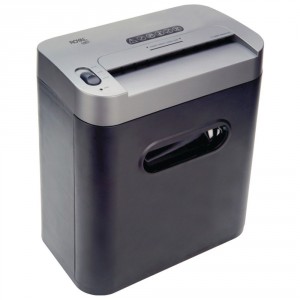
Straight-cut shredders have a quiet reputation problem. They turn paper into long, neat strips — not confetti. Stack those strips in order and you can reconstruct a page well enough to read account numbers, addresses, even signatures. That’s why the security standard for strip cut is P-2, the lowest rating worth mentioning. A basic cross-cut starts at P-3, and micro-cut pushes into P-4 or P-5. Those numbers come from DIN 66399, the German standard that tests how fine a shredder cuts and how hard the output is to reassemble. A P-2 strip cut (roughly a quarter-inch wide) earns a “restricted” clearance — fine for old grocery lists, not fine for anything carrying a name and a date of birth.
So why do people keep searching for the best straight-cut shredders? Partly habit. Strip-cut machines were the default for decades. They’re cheaper, faster, and less prone to jamming than micro-cut alternatives. Partly confusion — the term “straight cut” sometimes gets used interchangeably with “cross cut” at the budget end of the market, where listings blur the line between strip and confetti. And partly, honestly, because a lot of people just need to get rid of junk mail and don’t care if the pieces are small enough to survive an audit.
That tension is what this guide has to solve. Some buyers genuinely want a straight-cut shredder, but most think they want one when they actually need something much more secure. The search intent is “straight cut,” but the real need is “paper destroyed, identity protected, hassle minimal.”
Identity theft statistics have climbed every year for the past decade, and document disposal is one of the easiest vulnerabilities to fix. A shredder that leaves strips a child could reassemble in an afternoon isn’t closing that gap. Yet the average home office budget for a shredder hovers around $30–$50, right where strip-cut models live. Spend a little more — around $130 — and you’ll find micro-cut machines that turn a letter-sized page into hundreds of particles too small to reassemble.
This article walks through the options honestly. There are exactly two shredders here that deserve a full review, and one worth a quick mention for a specific kind of buyer.
What we’re covering (and what we’re not)
Full reviews:
- Aurora AU1210MA — micro-cut, P-4 security, 12-sheet capacity, 60-minute runtime, around $135. The machine for anyone who typed “straight cut shredder” into a search bar but actually needs real document security. It changes the conversation.
- Amazon Basics S120-E US — strip cut, P-2 security, 8-sheet capacity, basketless design, around $31. The budget option for non-sensitive shredding. It does exactly what it says.
Also worth a look:
- BONSEN S3104 — cross-cut, P-4 security, 20-sheet capacity, 60-minute runtime, around $220. A heavy-duty office machine in a different category that solves similar problems for high-volume environments.
Five models didn’t make the cut. You won’t see reviews for the Aurora AU800SD, the woolsche SD108, the bonsaii S120-C, or other strip-cut units that either duplicate the Amazon Basics pick at a higher price or add nothing useful. The strip-cut market is a commodity game: you want the cheapest reliable option, or you don’t want strip cut at all. No middle ground worth recommending.
Why read this entire guide before buying
Shredder marketing is aggressive and often misleading. A machine labeled “high security” might only deliver P-2 strip cut. A “commercial grade” unit might run for two minutes before needing a half-hour cooldown. Battery-powered shredders exist that can’t handle more than three sheets before the motor whines and stops. The product pages are written to sell, not to keep you safe.
This guide cuts through that. The recommendations are based on specs, user-reported performance over time, and real-world trade-offs. If you buy a strip-cut shredder after reading this, you’ll know exactly what it can and can’t protect. If you buy the micro-cut Aurora, you’ll understand why it’s the better investment for anything beyond junk mail.
The next sections compare the two featured models side by side, then dive deep into each one. After that, a short buyer’s guide covers the factors that actually matter — duty cycle, bin size, jam handling — the stuff people regret ignoring a month in.
Aurora AU1210MA
The Aurora AU1210MA isn’t what most people picture when they search for a straight-cut shredder. It’s micro-cut, which means it reduces paper to particles roughly the size of a standard hole punch dot, not the long strips a true straight-cut machine produces. That distinction matters far more than most realize, because the gap between P-2 security (strip cut) and P-4 security (micro cut) isn’t incremental — it’s fundamental.
The AU1210MA carries a P-4 rating under DIN 66399, the international standard for document destruction. P-4 is the threshold where shredded material becomes genuinely difficult to reassemble. A single letter-sized page gets reduced to roughly 2,000 tiny particles — each 5/32 by 15/32 inches — versus a P-2 strip cut that leaves maybe 50 long strips you could tape back together with patience. For anyone dealing with tax returns, legal correspondence, medical records, or client intake forms, P-4 isn’t a luxury; it’s the minimum reasonable investment. The AU1210MA delivers that security without forcing commercial-grade pricing.
Why the runtime matters
Most shredders under $150 run 10 to 20 minutes before needing a 30- to 60-minute cooldown. This one runs for 60 minutes straight. That’s the difference between shredding a full bag of documents in one session versus getting interrupted halfway through and waiting for the motor to cool. For a home office or small business with periodic heavy shredding—end-of-month cleanouts, client file purges, tax season—that hour makes it genuinely useful rather than frustrating.
It’s also quiet. “Quiet for a shredder” is usually faint praise, but this one doesn’t dominate the room—closer to an office conversation than the grating whine of a cheap strip cutter. In a shared workspace, that matters.
Where the compromises hit
Three real weaknesses stand out. First, the manual feed handles up to 12 sheets at a time, so you’re standing there feeding during long sessions. No auto-feed or batch loading. If you routinely clear a ream of paper, expect to spend ten minutes feeding 12 sheets at a time. Second, the bin is 5 gallons, and micro-cut particles are fluffy—they fill the bin faster than strips do. You’ll empty it several times during that 60-minute run. The shredder outlasts its own bin by a wide margin, which feels like a design oversight. Third, the price sits around $135—roughly three to four times what a basic strip-cut shredder costs.
Staples, cards, and jams
The AU1210MA accepts staples and small paper clips without complaint—no need to sort documents. It also has a dedicated slot for credit cards and CDs, standard for this class but still convenient. The anti-jam system uses auto-reverse: when the motor detects resistance, it reverses the cutters to eject the jammed paper, then you restart with a lighter load. It’s not flawless—overstuffing still causes hiccups—but it handles occasional mistakes better than machines that require manual clearing with a release lever. The LED indicators on the bin provide clear status updates, a rare convenience at this price.
A final thought on the search term
There’s irony in recommending a micro-cut shredder in a guide titled “Best Straight Cut Shredders.” But most people searching for straight-cut shredders don’t actually want strip-cutting security limitations. They want affordability and simplicity, and they assume those only come with strip-cut machines. The AU1210MA disproves that. It costs more upfront, but it delivers genuine protection without the headaches that plague cheap cutters. For anyone who needs to dispose of documents with personal or financial information, the extra cost eliminates a vulnerability a strip-cut machine would leave wide open.
Check Price → Aurora AU1210MA on Amazon
Amazon Basics S120-E US
At $31, the Amazon Basics S120-E is exactly what it says on the box. It’s a strip-cut shredder with a P-2 security rating, spitting out 0.24-inch wide strips that a patient person could tape back together in an afternoon. The cut quality is fine for junk mail, expired coupons, old receipts, or any non-sensitive paper you’d rather not toss whole into the recycling bin. Not fine for anything with a Social Security number or account balance.
The design deliberately omits a basket. An extendable arm lets the shredder sit on top of a standard wastebasket, saving desk space and eliminating the need to empty a dedicated bin. But you have to supply the basket. If you don’t have one that fits, the machine becomes awkwardly dependent on finding the right size.
The real limitation is the duty cycle. The S120-E runs for roughly two to three minutes before it needs a 30-minute cooldown. Feed six to eight sheets, wait, feed again. For light home use—when the mail pile grows once a week—it’s workable. For anything resembling a batch job, it becomes frustrating fast. There’s no auto-reverse or automated jam clearing. If the cutters bind, you’ll need to pry things loose manually.
It handles credit cards and CDs through a separate slot, which is nice, and the overheat protection at least prevents permanent damage. But the combination of slow throughput, short runtime, and low security makes this a machine for a very specific buyer: someone who shreds infrequently, cares about price above all, and understands that “destroyed” and “secure” are different things. For $31, that’s an honest trade.
Check Price → Amazon Basics S120-E US on Amazon
Also Worth a Look
BONSEN S3104. A cross-cut machine with a 20-sheet pass and hour-long runtime, built for offices where multiple people feed paper throughout the day. It’s quiet at 60 dB and holds 520 sheets in the bin. The caveat: at $220, you’re paying for volume, not micro-cut security.
At a Glance
| Product | Price | Key Spec | Rating | Best For | Where to Buy |
|---|---|---|---|---|---|
| Aurora AU1210MA | $135.78 | 12-sheet micro-cut, P-4, 60-min runtime | 4.7 | Home offices needing genuine document security | Check Price → |
| Amazon Basics S120-E US | $31.32 | 8-sheet strip cut, P-2, basketless | 4.6 | Occasional junk mail shredding on a tight budget | Check Price → |
| BONSEN S3104 | $219.99 | 20-sheet cross-cut, P-4, 60-min runtime | 4.7 | High-volume office shredding with minimal noise | Check Price → |
What to Actually Consider Before Buying
The shredders here cost $31 to $220. The difference isn’t quality—it’s what each machine is designed to protect you from. Strip cut, cross cut, micro cut: these aren’t just blade patterns. They’re different answers to the question “how hard should it be to steal my information?”
A few things to weigh.
Security level isn’t marketing, it’s a standard
DIN 66399 exists for a reason. P-1 and P-2 (strip cut) are “restricted” security—fine for general waste, not for personal data. P-4 (micro cut) is “highly confidential,” the threshold where shredded paper becomes impractical to reconstruct.
If you’re shredding bank statements, medical bills, tax documents, or anything with a signature, P-2 is a gamble. A strip 0.24 inches wide still carries readable text. A patient person with tape could reconstruct enough of a P-2 document to find account numbers. Micro-cut particles are smaller than a fingernail clipping—reassembling them would take more time than the information is worth to almost anyone.
So ask yourself: what’s in your trash? Mostly “Resident” junk mail? A strip-cut machine is fine. Mail with your name and account numbers? Go micro-cut. That distinction determines which shredder you need, regardless of budget.
Continuous run time matters more than sheet capacity
Sheet capacity is what manufacturers put in bold. But duty cycle—how long the machine runs before needing a cooldown—determines whether it’s useful for more than a single envelope.
The Amazon Basics S120-E runs about two minutes before needing a 30-minute cooldown. So if you have 50 pages to shred, you’ll feed 8 at a time, let the machine run for a couple of minutes, then wait 30 minutes before finishing the rest. For one or two bills a day, fine. For a monthly paperwork purge, it becomes a bottleneck.
The Aurora AU1210MA runs for 60 minutes straight. You can feed paper steadily, empty the bin a few times, and clear a real stack. Runtime is the biggest differentiator between a toy and a tool, and it correlates directly with price. If you shred in batches, prioritize runtime over sheet capacity.
Bin size determines how often you interrupt your rhythm
Micro-cut shredders produce fluffy, voluminous particles. A single page turns into a pile of confetti. The AU1210MA’s 5-gallon bin fills fast during long sessions—you’ll empty it several times during that 60-minute runtime. That’s physics: smaller particles take up more space.
Strip-cut machines output denser shreds, so bins last longer. The Amazon Basics S120-E has no bin at all: it fits any wastebasket, which is either convenient or annoying depending on whether you want a dedicated slide-out bin or just something to drop underneath.
Jam handling separates frustration from flow
Every shredder jams eventually—especially if you accidentally exceed the sheet capacity or feed crumpled paper. The difference is whether the machine clears itself or forces you to manually extract the jam.
The AU1210MA has auto-reverse: it detects resistance, reverses the cutters to eject the paper, and you restart with a lighter load. Works most of the time. The Amazon Basics S120-E lacks this. If it jams, you’ll use the manual reverse switch or pull the paper out. Over time that adds up. If you’d rather not wrestle with machinery, auto-reverse is worth paying for.
Media slots are secondary but nice
Most shredders in this range handle credit cards and CDs through a dedicated slot. The Aurora and Amazon Basics both do. It’s not a dealbreaker, but it’s convenient for expired cards (metal cards excluded—check before feeding).
One last thought on the search term
If you’re searching for a “straight cut shredder,” don’t focus on blade orientation. Focus on whether the output is secure enough for your trash. Strip cut: junk mail. Micro cut: documents that matter. Buy accordingly.
Which one to pick
No universal winner. The right shredder depends entirely on what you’re shredding.
If you handle documents with personal or financial information and want them genuinely destroyed—not just cut into ribbons—the Aurora AU1210MA is the pick. It’s not a strip-cut machine, but it solves the problem most people searching “straight cut shredder” actually have: secure disposal. The 60-minute runtime, auto-reverse, and P-4 micro-cut justify the cost for anyone who shreds in volume or values their time.
If you’re on a tight budget and just need to shred junk mail and catalogues once a week, the Amazon Basics S120-E US is an honest choice. It costs $31, drops onto any wastebasket, and eats credit cards. Just know its limits: P-2 security and a very short duty cycle. This isn’t built for sensitive documents or batch jobs.
For a shared office where multiple people feed paper all day, the BONSEN S3104 fills a specific niche—high sheet capacity, quiet operation, a 6.7-gallon bin. At $220, though, it’s a big investment for a cross-cut machine that doesn’t get you the particle size of a micro-cut shredder.
Match the machine to the threat. That’s the whole guide in one sentence.
Q: Can a straight cut shredder protect against identity theft?
A: No. Straight cut (strip cut) produces P-2 level strips that can be reassembled with patience. For identity protection, you need at least P-4 micro-cut or cross-cut security. The Aurora AU1210MA in this guide provides P-4 micro-cut particles that are effectively impossible to reconstruct.
Q: Why do most straight cut shredders have such short run times?
A: Budget strip-cut machines use small motors and minimal cooling, so they overheat after 2–3 minutes. The Aurora AU1210MA runs 60 minutes because it uses a higher-grade motor and better thermal management. If you shred in batches, prioritize continuous run time over sheet capacity.
Q: Do I need to remove staples before shredding?
A: Both the Aurora AU1210MA and Amazon Basics S120-E handle staples and small paper clips without issue. However, heavy-duty staples or binder clips can still jam cutters over time. Most home office shredders are designed to tolerate occasional staples, but removing them extends blade life.
Q: What’s the real-world difference between P-2 and P-4 security?
A: A P-2 strip cut leaves paper in ¼-inch wide ribbons—easy to tape back together. A P-4 micro-cut (like the Aurora) turns a single page into roughly 2,000 tiny particles. The time investment to reconstruct a P-4 document is measured in hours, while P-2 strips can be reassembled in minutes. For sensitive data, P-4 is the minimum.
Q: Can these shredders handle credit cards and CDs?
A: Yes, the Aurora, Amazon Basics, and BONSEN all have dedicated slots for credit cards and CDs. None handle metal or embossed cards. For plastic cards, feed them one at a time through the media slot to avoid jamming.
Q: How often should I oil my shredder?
A: For any shredder used weekly, oil the cutters every time you empty the bin or after every 30 minutes of continuous use. Use shredder oil, not substitutes. The Aurora AU1210MA’s cutters benefit from regular lubrication to maintain jam resistance and quiet operation.