The search for a compact charcoal grill usually ends not with the best specifications, but with the one that fits your actual space and routine. If you live in an apartment with a tiny balcony, or need something that travels easily to a campsite without dominating your trunk, the choices narrow fast.
After sorting through the dozen or so credible options in the sub-$200 space for 2026, one grill keeps coming up as the most flexible for small-space cooking: the Oklahoma Joe’s Rambler. It’s not the cheapest, but it earns its price in ways that become obvious after a few cooks. That said, there are solid alternatives at nearly every price point, from the $20 Gas One to the premium Innochef.
Here’s what actually matters when you’re cooking on a balcony or picnic table—and which grills deserve your money.
Oklahoma Joe’s Rambler – The Adjustable Heat Control Makes It
$169.46 | 4.7 stars
The Rambler is the grill that makes you wonder why more portable charcoal grills don’t have adjustable charcoal trays. Simple reason: cost. The mechanism adds weight and complexity. But once you’ve used one, you’ll resent grills that don’t let you move the coals closer for searing or further away for low-and-slow cooking.
The 218-square-inch cooking area is realistic for two people cooking burgers and vegetables simultaneously, maybe three if you’re careful. The real selling point isn’t size—it’s that you can actually control temperature beyond opening and closing vents. The charcoal tray slides up and down on a metal track, and it’s sturdy enough to hold a full chimney of coals without wobbling.
Construction is heavy steel with a powder-coated finish. It’s not lightweight at roughly 25 pounds, but the carry handle is positioned well enough that it doesn’t feel awkward. The lid has a built-in thermometer, which is common at this price point, but the placement is sensible—you can read it without crouching.
Downsides: The legs are fixed, not foldable, so it takes up more storage space than the truly compact options. On a small balcony, that matters. The cooking grate is steel, not porcelain-coated, so it requires more aggressive cleaning and seasoning. Some owners report surface rust after a few months of exposure, though that’s manageable with maintenance.
The Rambler is best for someone who wants legitimate temperature control without graduating to a full-sized offset smoker. If you’re cooking for more than two people regularly, the 218 square inches will feel cramped.
Fire Sense 60508 Notebook Gril – The Minimalist’s Choice
$29.17 | 4.4 stars
The Fire Sense Notebook Grill looks like something you’d fold out of sheet metal in a workshop, but that’s exactly the point. It unfolds from a flat rectangle (roughly the size of a laptop case) into a functional grill standing 13 inches high. No screws, no assembly, no tools.
At this price, expectations should be realistic. The grates are thin chrome-plated steel. The legs are simple metal flaps that lock into place with tabs. There’s no lid, no thermometer, no adjustable vents—just a shallow charcoal pan and a grate above it. It gets hot, it cooks food, and it fits in a backpack.
For balcony use, the lack of a lid means heat escapes quickly, so cooking outside when it’s windy is frustrating. The short height also means you’re cooking in a smoke cloud if you’re not careful. Ash cleanup is as simple as dumping the pan, but the thin metal can warp after repeated high-heat use. Some owners report the locking tabs bending after a dozen uses.
The Notebook is best for infrequent use: a couple of summer cookouts, camping trips where weight matters more than performance, or as a backup grill that lives in your trunk. It’s not for anyone who wants consistent results or cooks more than once a week.
If you’re considering this versus the Gas One CG-14, the Gas One is $8 cheaper and has a lid. That seems like a better deal unless folding flat is the priority.
Weber Jumbo Joe 18″ – The Safe Bet with a Lid Flaw
$89.99 | 4.8 stars
Weber’s 18-inch Jumbo Joe is the middle child in their portable lineup: bigger than the Smokey Joe 14″, smaller than the full-sized kettles. It’s the most balanced option if you need something that can handle two steaks plus vegetables without feeling like a toy.
The porcelain-enameled bowl and lid are genuinely durable. After years of use and exposure, the finish holds up far better than the painted steel on cheaper competitors. The 240-square-inch cooking area is generous for a portable grill—enough for 6-8 burgers or a whole chicken spatchcocked flat.
The Tuck-N-Carry lid lock works as advertised, but it’s worth noting that the latch mechanism uses plastic components that can wear out over time. The one glass-reinforced nylon handle is adequate but gets uncomfortably hot during longer cooks. Adding a second handle on the opposite side would have been practical.
The real frustration with the Jumbo Joe is the lack of air control. You get a single aluminum damper at the bottom and the lid vent. That’s fine for most cooking, but if you want to hold lower temperatures for longer, you’ll be fighting the design. The Oklahoma Joe’s Rambler is dramatically better in this regard.
That said, the Jumbo Joe is widely available, easy to find replacement parts for, and Weber’s customer service is genuinely responsive. If you want reliability and brand support over advanced features, this is the pick.
Innochef CB18003P – Compact, Versatile, and Surprisingly Capable
$82.95 | 4.9 stars
The Innochef CB18003P is the grill that caught me off guard. It’s compact, foldable, and weighs only 13 pounds, yet it manages to include features you’d normally expect on grills twice the price: a built-in thermometer, adjustable air vent, and foldable legs with a locking buckle.
The 18-inch cooking grate provides roughly 200 square inches of surface area, which is realistic for two people. The thermometer on the lid is positioned well and seems reasonably accurate, though it’s not going to match a dedicated probe for precision. The adjustable air vent at the bottom gives you more control than most grills at this size.
The standout feature is the foldability. The legs collapse completely, and the locking buckle secures everything into a compact package. At 13 pounds, it’s genuinely easy to carry with one hand. That matters if you’re carrying it up stairs to a balcony or packing it into a trunk with other gear.
Construction is a mixed bag. The steel body is thick enough to hold heat, but the paint finish is prone to scratching during transport. The cooking grate is chrome-plated steel, which is acceptable at this price but will require seasoning to prevent rust. Some early buyers reported that the leg lock mechanism developed play after several uses, though that hasn’t been widespread.
Where the Innochef falls short is in long-term durability. The Weber Jumbo Joe will outlast it by years. But for casual use—a few weekends a month—the Innochef offers more features in a lighter package than almost anything else at this price.
Weber Smokey Joe 14″ – The Classic, But the Smallest Option
$54.99 | 4.6 stars
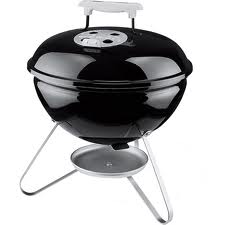
The Smokey Joe is the grill that appears in college dorms, camping sites, and apartment balconies across the country. It’s been around long enough that almost everyone recognizes it. The 14-inch cooking grate provides roughly 150 square inches, which is enough for 6 burgers or a few chicken breasts.
The Tuck-N-Carry lid lock is the same design as the Jumbo Joe, but scaled down. It works, though the plastic components are the same quality. The porcelain-enameled finish is good for the price and resists rust.
The problem with the Smokey Joe is that it’s genuinely small. Cooking for two people is fine. Cooking for three or four requires multiple rounds or keeping food warm in the oven. The shallow bowl also means the charcoal sits close to the grate, making it hard to cook thick cuts without charring the exterior.
If you’re cooking for one or two people and storage space is extremely limited, the Smokey Joe works. But the extra $35 to jump to the Jumbo Joe provides nearly 60% more cooking area and significantly more flexibility. The Smokey Joe is a compromise that makes sense only when space is the absolute priority.
Comparison Table
| Product | Price | Key Strength | Main Drawback | Best Fit | Rating |
|---|---|---|---|---|---|
| Oklahoma Joe’s Rambler | ~$170 | Adjustable charcoal tray for heat control | Heavy, non-foldable legs | Serious cooks who want temperature control | 4.7 |
| Weber Jumbo Joe 18″ | ~$90 | Durable porcelain finish, brand support | Limited air control, plastic lid lock | Regular users wanting reliability | 4.8 |
| Innochef CB18003P | ~$83 | Lightweight, foldable, built-in thermometer | Paint finish scratches easily | Frequent travelers and balcony users | 4.9 |
| Weber Smokey Joe 14″ | ~$55 | Iconic design, very compact, good finish | Too small for more than 1-2 people | Solo cooks or extreme space constraints | 4.6 |
| Fire Sense Notebook | ~$29 | Folds completely flat, ultralight | No lid, thin metal, limited heat control | Infrequent use, backpacking | 4.4 |
Buyer’s Guide: What You’ll Actually Regret Ignoring
Lid design matters more than insulation
With a portable charcoal grill, the lid’s primary job isn’t insulating—it’s trapping smoke and heat so the grill acts like an oven. A lid that doesn’t seal properly leaks heat, makes temperature control harder, and wastes charcoal. The Weber grills seal well because of the kettle shape. The Oklahoma Joe’s has a heavier lid that sits flush. Cheap flat lids, like on the Fire Sense Notebook, are essentially useless for smoking or low-temperature cooking.
Adjustable charcoal management changes everything
This is the feature that turns a mediocre grill into a genuinely useful cooking tool. The Oklahoma Joe’s Rambler is the only grill in this list with a height-adjustable charcoal tray, but that single feature makes it capable of both searing steaks at 500°F and smoking ribs at 250°F. Most other options force you to manage heat by adding or removing charcoal, which is messy and imprecise. If you cook more than one type of food regularly, prioritize this.
Weight is a trade-off, not a flaw
A 13-pound grill like the Innochef is easy to carry but feels flimsy during use. A 25-pound grill like the Oklahoma Joe’s feels solid but is annoying to move. There’s no perfect balance—you have to decide whether portability or cooking stability matters more. If your grill lives on a balcony and rarely moves, weight barely matters. If you pack it in and out of a car every weekend, it’s the most important factor.
Cleaning reality
Every compact grill requires some form of ash disposal. The Weber models have a removable ash catcher that makes cleanup relatively clean. The Oklahoma Joe’s has a trap door at the bottom. The Innochef and Fire Sense require tipping the grill to dump ash, which creates a mess. If you’re on a balcony and don’t have a garden hose, the ash catcher matters a lot. Cold water on hot ash also produces steam that can crack cheap porcelain finishes—learn to wait.
FAQ
How do you start a portable charcoal grill?
Use a chimney starter rather than lighter fluid. Fill the chimney with charcoal, place crumpled newspaper underneath, and light it. After 15-20 minutes, the coals are ready to pour into the grill. This avoids chemical flavors and is more reliable than electric starters in outdoor settings.
How do you dispose of charcoal after grilling on a balcony?
Let the ashes sit for at least 48 hours to fully cool. Place them in a metal container with a lid—never plastic or cardboard. Many apartment buildings have specific disposal rules for charcoal ash, so check with your building management. Never dump hot ash in a trash can or down a drain.
Can a portable charcoal grill fit in a car?
Most of the grills here fit in a standard sedan trunk when folded or disassembled. The Weber Jumbo Joe and Smokey Joe fit without disassembly. The Oklahoma Joe’s Rambler requires a larger trunk or may need to go in the back seat. The Fire Sense Notebook fits in a backpack.
How to choose the right type of charcoal for compact grills?
For smaller cooking surfaces, lump charcoal burns hotter and produces less ash than briquettes. It’s harder to control temperature with lump charcoal because individual pieces vary in size. Briquettes like Kingsford Original burn consistently and are easier to arrange in a small space. For smoking, use briquettes. For searing, use lump.
The compact charcoal grill market in 2026 is more about trade-offs than breakthroughs. The Oklahoma Joe’s Rambler offers the best versatility for anyone willing to spend around $170. The Weber Jumbo Joe remains the safe middle-ground option. And the Fire Sense Notebook is cheap enough that buying one to test the hobby is less risky than committing to a premium grill you might not use.
The grill you actually use every week is usually the one that fits your space, your cleaning tolerance, and your willingness to learn temperature control—not the one with the longest feature list.